
Can exercise make cancer patients live longer?

Yes, exercise can make cancer patients live longer.

A recent study of bowel cancer patients showed that people who had a “structured exercise program” had better fitness and a longer life.

The study data was presented at the prestigious annual meeting of the American Society of Clinical Oncology (ASCO) at Chicago.

Dr Sundar is a member of American Society of Clinical Oncology (ASCO) and has been a member for more than 25 years.

References

  1. ASCO abstract. A randomized phase III trial of the impact of a structured exercise program on disease-free survival (DFS) in stage 3 or high-risk stage 2 colon cancer: Canadian Cancer Trials Group (CCTG) CO.21 (CHALLENGE).
  2. CNN news. Exercise may help patients with colon cancer live as long as those who never had it, study suggests
    By Madeline Holcombe, CNN
     4 minute read
    Published 3:02 PM EST, Mon February 24, 2025
  3. CNN. New research presents promising findings on colorectal cancer treatment and prevention
  4. BBC news. Major study shows exercise improves cancer survival.

Disclaimer: Please note – This blog is NOT medical advice. This blog is NOT a expert medical opinion on various topics. This blog is purely for information research only and do check the sources where cited. Please DO consult your own doctor to discuss concerns and options, which are relevant and specific to you. The views expressed in this blog are NOT, in any way whatsoever, intended to be a substitute for professional advice. The blog is NOT previewed, commissioned or otherwise endorsed, in any way, by any organisation that the author is associated with. The views expressed in this blog likely represents some of the author’s personal views held at the time of drafting the blog and MAY CHANGE overtime, particularly when new evidence comes to light.
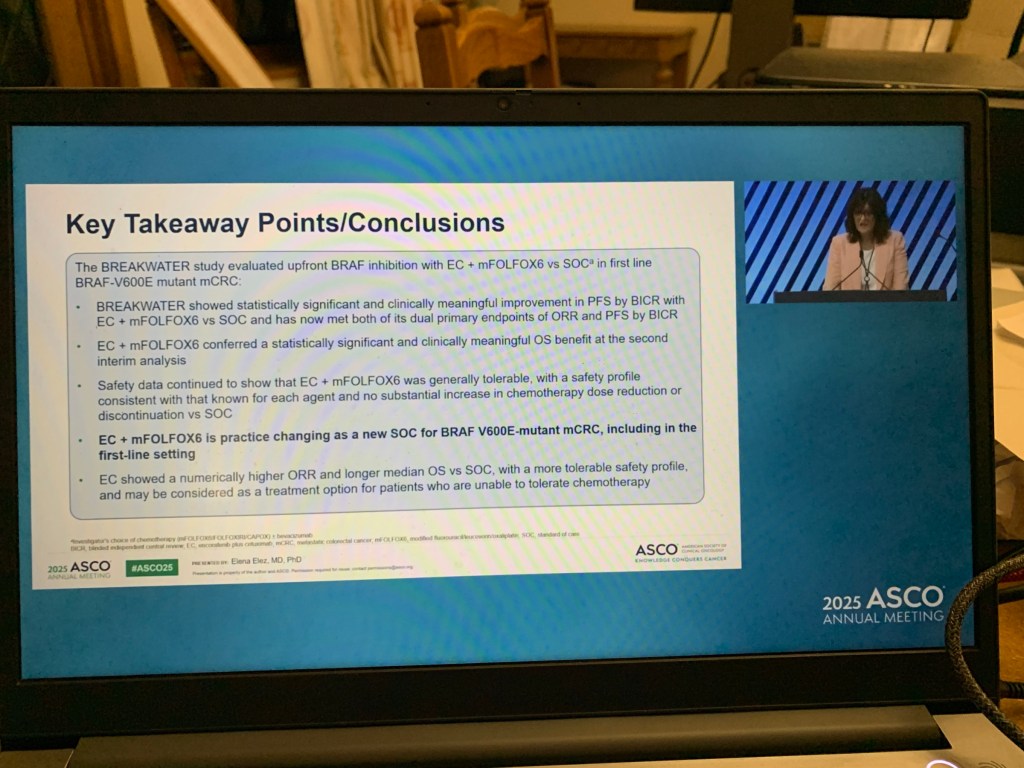
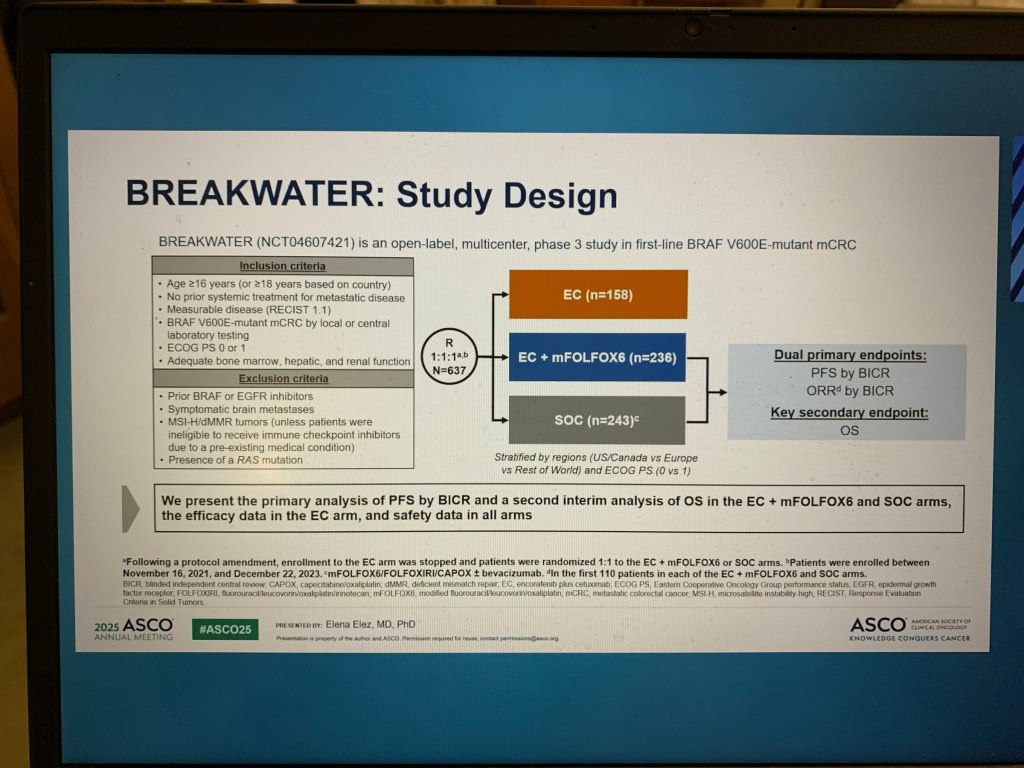
New treatment option for a subset of bowel cancer patients

Advanced bowel cancer is usually treated with chemotherapy.

A subset of bowel cancers carry a genetic change called BRAF V600E mutation.

These patients benefit from addition of a drug called Encorafenib to the chemotherapy drugs.

This treatment regimen will become the standard of care for this sub-group of patients.

The study data was presented at the prestigious annual meeting of the American Society of Clinical Oncology (ASCO) at Chicago.

The results were also published in the prestigious NEJM New England Journal of Medicine.

Dr Sundar is a member of American Society of Clinical Oncology (ASCO) and has been a member for more than 25 years.

References

  1. ASCO. First-line encorafenib + cetuximab + mFOLFOX6 in BRAF V600E-mutant metastatic colorectal cancer (BREAKWATER): Progression-free survival and updated overall survival analyses.
  2. NEJM. Encorafenib, Cetuximab, and mFOLFOX6 in BRAF-Mutated Colorectal Cancer
    Authors: Elena Elez, M.D., Ph.D., Takayuki Yoshino, M.D., Ph.D., Lin Shen, M.D., Sara Lonardi, M.D., Eric Van Cutsem, M.D., Ph.D., Cathy Eng, M.D., Tae Won Kim, M.D., Ph.D., +13 , for the BREAKWATER Trial Investigators*Author Info & Affiliations
    Published May 30, 2025
    DOI: 10.1056/NEJMoa2501912
    Copyright © 2025

Disclaimer: Please note – This blog is NOT medical advice. This blog is NOT a expert medical opinion on various topics. This blog is purely for information research only and do check the sources where cited. Please DO consult your own doctor to discuss concerns and options, which are relevant and specific to you. The views expressed in this blog are NOT, in any way whatsoever, intended to be a substitute for professional advice. The blog is NOT previewed, commissioned or otherwise endorsed, in any way, by any organisation that the author is associated with. The views expressed in this blog likely represents some of the author’s personal views held at the time of drafting the blog and MAY CHANGE overtime, particularly when new evidence comes to light.

New drug for platinum resistant ovarian cancer

Multiple new drugs have been developed lung and breast cancers over the last decade.

But only a few new drugs have been approved for ovarian cancers in the past decade.

Drugs like Olaparib and Niraparib – which have been approved for ovarian cancers recently – are maintenance drugs used after chemotherapy rather than used as an upfront treatment .

So it is very good news that a brand new drug is likely to enter the market in the near future.

The new drug is called Relacorilant.(Rela).

It has been tested in ovarian cancers which have become resistant to the platinum drugs.

Platinum drugs are the standard of care ovarian cancers and most other drugs do not work very well once ovarian cancers have become resistant to carboplatin or cisplatin (platinum resistant ovarian cancers).

So it is very good news that we may have a new option now for this group of patients with platinum resistant ovarian cancers.

Early phase drug trial results of Rela in 2023 were promising but not definitive.

Advanced phase 3 trials of Rela have been positive in improving survival (2025).

The study results were due to presented at the prestigious annual meeting of the American Society of Clinical Oncology (ASCO) at Chicago.( June 2025).

Dr Sundar is a member of American Society of Clinical Oncology (ASCO) and has been a member for more than 25 years.

References

1. Relacorilant + Nab-Paclitaxel in Patients With Recurrent, Platinum-Resistant Ovarian Cancer: A Three-Arm, Randomized, Controlled, Open-Label Phase II Study
Nicoletta Colombo et al. J Clin Oncol. 2023.

2. Targeted oncology. News Article. March 31, 2025. Relacorilant Extends Survival in Platinum-Resistant Ovarian Cancer Mar 31, 2025 . By Jordyn Sava. Fact checked by: Jason M. Broderick

3. ROSELLA: A phase 3 study of relacorilant in combination with nab-paclitaxel versus nab-paclitaxel monotherapy in patients with platinum-resistant ovarian cancer (GOG-3073, ENGOT-ov72).

Disclaimer: Please note – This blog is NOT medical advice. This blog is NOT a expert medical opinion on various topics. This blog is purely for information research only and do check the sources where cited. Please DO consult your own doctor to discuss concerns and options, which are relevant and specific to you. The views expressed in this blog are NOT, in any way whatsoever, intended to be a substitute for professional advice. The blog is NOT previewed, commissioned or otherwise endorsed, in any way, by any organisation that the author is associated with. The views expressed in this blog likely represents some of the author’s personal views held at the time of drafting the blog and MAY CHANGE overtime, particularly when new evidence comes to light.

Can applying some electric current make chemotherapy work better in pancreatic cancer ?

Yes !

Applying electricity to tumours can help to improve control of pancreatic cancer.

The procedure is called TTfFields.

The procedure is not invasive.

The procedure uses low-energy electricity which impedes cancer cells’ ability to grow and divide.

The procedure is done alongside standard chemotherapy .

The TTFields electric treatments has already been tested and has shown promise in brain tumours and lung cancers.

A study presented at the Chicago ASCO meeting shows better survival in patients who had TTFields electricity in addition to their usual chemotherapy regimen of gemcitabine and abraxane (nab-paclitaxel) for pancreatic cancer.

The study data was presented at the prestigious annual meeting of the American Society of Clinical Oncology (ASCO) at Chicago.

Dr Sundar is a member of American Society of Clinical Oncology (ASCO) and has been a member for more than 25 years.

References

  1. Tumour treating fields therapy for glioblastoma: current advances and future directions. British Journal of Cancer volume 124, pages 697–709 (2021)
  2. Weinberg U, Farber O, Giladi M, Bomzon Z, Kirson ED. Tumor treating field concurrent with standard of care for stage 4 non-small cell lung cancer (NSCLC) following platinum failure: Phase III LUNAR study. [abstract]. ESMO, October 2018. Ann Oncol. 2018;29:viii543. doi: 10.1093/annonc/mdy292.120.
  3. Lancet oncology. Tumor Treating Fields therapy with standard systemic therapy versus standard systemic therapy alone in metastatic non-small-cell lung cancer following progression on or after platinum-based therapy (LUNAR): a randomised, open-label, pivotal phase 3 study.
  4. Wiki. Alternating electric field therapy.
  5. PANOVA-3: Phase 3 study of tumor treating fields (TTFields) with gemcitabine and nab-paclitaxel for locally advanced pancreatic ductal adenocarcinoma (LA-PAC) .

Disclaimer: Please note – This blog is NOT medical advice. This blog is NOT a expert medical opinion on various topics. This blog is purely for information research only and do check the sources where cited. Please DO consult your own doctor to discuss concerns and options, which are relevant and specific to you. The views expressed in this blog are NOT, in any way whatsoever, intended to be a substitute for professional advice. The blog is NOT previewed, commissioned or otherwise endorsed, in any way, by any organisation that the author is associated with. The views expressed in this blog likely represents some of the author’s personal views held at the time of drafting the blog and MAY CHANGE overtime, particularly when new evidence comes to light.

Hormone tablet Abiraterone for prostate cancer treated with curative intent

Prostate cancer can be treated with curative intent if it is localised to pelvis.

But in patients with high risk cancers, additional treatments might be needed to improve the odds of controlling the cancer.

Abiraterone is one such add-on treatment that has been shown to improve long term outcomes in a large UK trial.

Unfortunately the drug, abiraterone, even though it is much cheaper now, is not widely available in the UK National Health System ( NHS).

Now an AI (artificial intelligence) test has been developed which selects better those patients who are likely to benefit from Abiraterone.

Hopefully the test will become available for routine use in the near future.

The study data was presented at the prestigious annual meeting of the American Society of Clinical Oncology (ASCO) at Chicago.

Dr Sundar is a member of American Society of Clinical Oncology (ASCO) and has been a member for more than 25 years.

References

BBC news. Hugh Pym and Ian Atkinson. Men denied life-extending prostate cancer drug

UCL. AI test to determine best prostate cancer treatment could save lives and money. 30 May 2025.

Daily Telegraph. Give prostate cancer patients drug that halves risk of death, NHS told.

SUN Newspaper.

Disclaimer: Please note – This blog is NOT medical advice. This blog is NOT a expert medical opinion on various topics. This blog is purely for information research only and do check the sources where cited. Please DO consult your own doctor to discuss concerns and options, which are relevant and specific to you. The views expressed in this blog are NOT, in any way whatsoever, intended to be a substitute for professional advice. The blog is NOT previewed, commissioned or otherwise endorsed, in any way, by any organisation that the author is associated with. The views expressed in this blog likely represents some of the author’s personal views held at the time of drafting the blog and MAY CHANGE overtime, particularly when new evidence comes to light.
Can some advanced kidney cancer patients be managed by wait and watch only ?

Yes !

When the cancer is advanced , the natural inclination of doctors and patients is chose immediate therapy .

This is the logical and correct thing to do in many cancer patients.

But there are exceptions!

For example, it is well known that some advanced kidney cancer patients can be managed by “active surveillance” or “wait and watch policy” ONLY without any immediate cancer treatment.

A study presented at a Cancer meeting in Chicago confirms that this approach is safe and feasible in “carefully selected” patients.

The study patients who were managed by “active surveillance” or “wait and watch policy” ONLY had preservation of quality of life compared to patients on cancer treatments.

This approach is reassuring but this approach is not for everyone; the study is about kidney cancer patients only. Not other cancers. Patients do need to make an informed choice after discussing the option with their oncologists.

The study data was presented at the prestigious annual meeting of the American Society of Clinical Oncology (ASCO) at Chicago.

Dr Sundar is a member of American Society of Clinical Oncology (ASCO) and has been a member for more than 25 years.

References

American Society of Clinical Oncology (ASCO) 2025. Real-world quality of life (QOL) in patients (pts) with metastatic renal cell carcinoma (mRCC) on active surveillance (AS) in the ODYSSEY prospective observational study. Publication: Journal of Clinical Oncology.

Disclaimer: Please note – This blog is NOT medical advice. This blog is NOT a expert medical opinion on various topics. This blog is purely for information research only and do check the sources where cited. Please DO consult your own doctor to discuss concerns and options, which are relevant and specific to you. The views expressed in this blog are NOT, in any way whatsoever, intended to be a substitute for professional advice. The blog is NOT previewed, commissioned or otherwise endorsed, in any way, by any organisation that the author is associated with. The views expressed in this blog likely represents some of the author’s personal views held at the time of drafting the blog and MAY CHANGE overtime, particularly when new evidence comes to light.
More pancreatic cancer patients may benefit from immunotherapy

Immunotherapy has revolutionised cancer treatment over the last few years . But, sadly, not all cancer patients derive benefit from the costly immunotherapy drugs

For instance, almost, all advanced kidney or skin melanoma cancer patients are eligible to try immunotherapy. But only about 1% of patients with pancreatic cancer are at present eligible for immunotherapy .

A new study suggests more people with pancreatic cancer may be eligible for immunotherapy. 

The preliminary data from a good quality early study (randomized phase II trial) is interesting.

The study compared treatment with gemcitabine (G) and nab-paclitaxel (N) with and without dual immunotherapy treatment with durvalumab (D) and tremelimumab (T) as 1st-line therapy in patients with advanced pancreatic cancer. 

In this study, only a subset of patients derived benefit from the dual combination therapy. 

Subsequent molecular and genetic analysis showed that the presence of certain gene mutations (≥2 DDR) was strongly associated with benefit from the combination of chemotherapy with dual immune checkpoint inhibitor therapy. 

These intriguing exploratory data analysis needs confirmatory data before the combination therapy become the standard of care for advanced pancreatic cancer patients.

The study data was presented at the prestigious annual meeting of the American Society of Clinical Oncology (ASCO) hosted at Chicago.

Dr Sundar is a member of American Society of Clinical Oncology (ASCO) and has been a member for more than 25 years.

References

American Society of Clinical Oncology (ASCO) 2025: Concurrent mutations in DNA damage repair genes BRCA1, POLE, ATM and FANCA to predict overall and progression-free survival for patients (pts) with metastatic pancreatic ductal adenocarcinoma (mPDAC) treated with chemotherapy in combination with dual checkpoint inhibition in the CCTG randomized PA.7 trial.

Evaluating Mismatch Repair Deficiency in Pancreatic Adenocarcinoma: Challenges and Recommendations. Clin Cancer Res (2018) 24 (6): 1326–1336.

Disclaimer: Please note – This blog is NOT medical advice. This blog is NOT a expert medical opinion on various topics. This blog is purely for information research only and do check the sources where cited. Please DO consult your own doctor to discuss concerns and options, which are relevant and specific to you. The views expressed in this blog are NOT, in any way whatsoever, intended to be a substitute for professional advice. The blog is NOT previewed, commissioned or otherwise endorsed, in any way, by any organisation that the author is associated with. The views expressed in this blog likely represents some of the author’s personal views held at the time of drafting the blog and MAY CHANGE overtime, particularly when new evidence comes to light.

Immunotherapy makes advanced head and neck cancer patients live longer

Immunotherapy has revolutionised the care of many patients with kidney, bladder, skin and various other cancers.

Now a UK led study has shown that given the immunotherapy drug- pembrolizumab – before and after surgery– makes people live substantially longer.

Pembrolizumab is a very costly drug with limited affordability in developing countries.

In western countries, only people with private medical insurance or people having a publicly funded health systems such as NHS can afford it.

The fascinating immunotherapy data was presented at the prestigious annual meeting of the American Society of Clinical Oncology (ASCO) at Chicago.

Dr Sundar is a member of American Society of Clinical Oncology (ASCO) for more than 25 years.

References

  1. BBC News. Breakthrough cancer drug doubles survival in trial. Philippa Roxby
    Heath Reporter. May 2025.
  2. American Society of Clinical Oncology (ASCO) 2025: Neoadjuvant and adjuvant pembrolizumab plus standard of care (SOC) in resectable
    locally advanced head and neck squamous cell carcinoma (LA HNSCC): Exploratory
    efficacy analyses of the phase 3 KEYNOTE-689 study
    . ( Distant Metastasis-Free Survival (DMFS) data:
    Median DMFS was 51.8 months with pembrolizumab + SOC versus 35.7 months with SOC (HR 0.71, 95% CI 0.56–0.90).
    Estimated DMFS rate at 36 months was 59.1% versus 49.0%, respectively. )
  3. American Association for Cancer Research (AACR) Annual Meeting. 2025. Addition of Perioperative Pembrolizumab to Standard of Care in Newly Diagnosed Locally Advanced Head and Neck Cancer.
  4. Pembrolizumab With or Without Chemotherapy in Recurrent or Metastatic Head and Neck Squamous Cell Carcinoma: Updated Results of the Phase III KEYNOTE-048 Study.

Disclaimer: Please note – This blog is NOT medical advice. This blog is NOT a expert medical opinion on various topics. This blog is purely for information research only and do check the sources where cited. Please DO consult your own doctor to discuss concerns and options, which are relevant and specific to you. The views expressed in this blog are NOT, in any way whatsoever, intended to be a substitute for professional advice. The blog is NOT previewed, commissioned or otherwise endorsed, in any way, by any organisation that the author is associated with. The views expressed in this blog likely represents some of the author’s personal views held at the time of drafting the blog and MAY CHANGE overtime, particularly when new evidence comes to light.