New drug for platinum resistant ovarian cancer

Multiple new drugs have been developed lung and breast cancers over the last decade.

But only a few new drugs have been approved for ovarian cancers in the past decade.

Drugs like Olaparib and Niraparib – which have been approved for ovarian cancers recently – are maintenance drugs used after chemotherapy rather than used as an upfront treatment .

So it is very good news that a brand new drug is likely to enter the market in the near future.

The new drug is called Relacorilant.(Rela).

It has been tested in ovarian cancers which have become resistant to the platinum drugs.

Platinum drugs are the standard of care ovarian cancers and most other drugs do not work very well once ovarian cancers have become resistant to carboplatin or cisplatin (platinum resistant ovarian cancers).

So it is very good news that we may have a new option now for this group of patients with platinum resistant ovarian cancers.

Early phase drug trial results of Rela in 2023 were promising but not definitive.

Advanced phase 3 trials of Rela have been positive in improving survival (2025).

The study results were due to presented at the prestigious annual meeting of the American Society of Clinical Oncology (ASCO) at Chicago.( June 2025).

Dr Sundar is a member of American Society of Clinical Oncology (ASCO) and has been a member for more than 25 years.

References

1. Relacorilant + Nab-Paclitaxel in Patients With Recurrent, Platinum-Resistant Ovarian Cancer: A Three-Arm, Randomized, Controlled, Open-Label Phase II Study
Nicoletta Colombo et al. J Clin Oncol. 2023.

2. Targeted oncology. News Article. March 31, 2025. Relacorilant Extends Survival in Platinum-Resistant Ovarian Cancer Mar 31, 2025 . By Jordyn Sava. Fact checked by: Jason M. Broderick

3. ROSELLA: A phase 3 study of relacorilant in combination with nab-paclitaxel versus nab-paclitaxel monotherapy in patients with platinum-resistant ovarian cancer (GOG-3073, ENGOT-ov72).
Disclaimer: Please note – This blog is NOT medical advice. This blog is NOT a expert medical opinion on various topics. This blog is purely for information research only and do check the sources where cited. Please DO consult your own doctor to discuss concerns and options, which are relevant and specific to you. The views expressed in this blog are NOT, in any way whatsoever, intended to be a substitute for professional advice. The blog is NOT previewed, commissioned or otherwise endorsed, in any way, by any organisation that the author is associated with. The views expressed in this blog likely represents some of the author’s personal views held at the time of drafting the blog and MAY CHANGE overtime, particularly when new evidence comes to light.

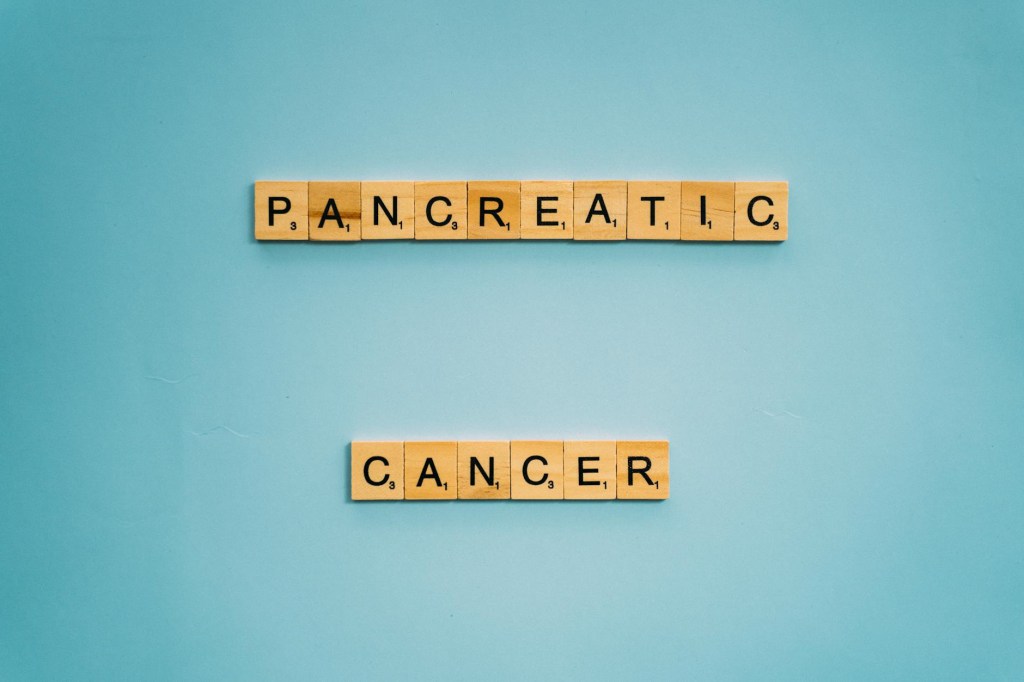
Can applying some electric current make chemotherapy work better in pancreatic cancer ?

Yes !

Applying electricity to tumours can help to improve control of pancreatic cancer.

The procedure is called TTfFields.

The procedure is not invasive.

The procedure uses low-energy electricity which impedes cancer cells’ ability to grow and divide.

The procedure is done alongside standard chemotherapy .

The TTFields electric treatments has already been tested and has shown promise in brain tumours and lung cancers.

A study presented at the Chicago ASCO meeting shows better survival in patients who had TTFields electricity in addition to their usual chemotherapy regimen of gemcitabine and abraxane (nab-paclitaxel) for pancreatic cancer.

The study data was presented at the prestigious annual meeting of the American Society of Clinical Oncology (ASCO) at Chicago.

Dr Sundar is a member of American Society of Clinical Oncology (ASCO) and has been a member for more than 25 years.

References

  1. Tumour treating fields therapy for glioblastoma: current advances and future directions. British Journal of Cancer volume 124, pages 697–709 (2021)
  2. Weinberg U, Farber O, Giladi M, Bomzon Z, Kirson ED. Tumor treating field concurrent with standard of care for stage 4 non-small cell lung cancer (NSCLC) following platinum failure: Phase III LUNAR study. [abstract]. ESMO, October 2018. Ann Oncol. 2018;29:viii543. doi: 10.1093/annonc/mdy292.120.
  3. Lancet oncology. Tumor Treating Fields therapy with standard systemic therapy versus standard systemic therapy alone in metastatic non-small-cell lung cancer following progression on or after platinum-based therapy (LUNAR): a randomised, open-label, pivotal phase 3 study.
  4. Wiki. Alternating electric field therapy.
  5. PANOVA-3: Phase 3 study of tumor treating fields (TTFields) with gemcitabine and nab-paclitaxel for locally advanced pancreatic ductal adenocarcinoma (LA-PAC) .

Disclaimer: Please note – This blog is NOT medical advice. This blog is NOT a expert medical opinion on various topics. This blog is purely for information research only and do check the sources where cited. Please DO consult your own doctor to discuss concerns and options, which are relevant and specific to you. The views expressed in this blog are NOT, in any way whatsoever, intended to be a substitute for professional advice. The blog is NOT previewed, commissioned or otherwise endorsed, in any way, by any organisation that the author is associated with. The views expressed in this blog likely represents some of the author’s personal views held at the time of drafting the blog and MAY CHANGE overtime, particularly when new evidence comes to light.

New treatment regimen for bladder cancer

Giving chemotherapy before surgical removal of bladder for invasive cancer is the current standard of care.

Immunotherapy is often used in later stages of treatment for bladder cancer. Now it is being tested in early bladder cancers.

A new study has found that adding immunotherapy drug ( Durvalumab) to existing standard treatment improves the survival outcomes .

Reference

NEJM: Perioperative Durvalumab with Neoadjuvant Chemotherapy in Operable Bladder Cancer.

Disclaimer: Please note – This blog is NOT medical advice. This blog is NOT a expert medical opinion on various topics. This blog is purely for information only and do check the sources where cited. Please DO consult your own doctor to discuss concerns and options relevant to you. The views expressed in this blog are NOT, in any way whatsoever, intended to be a substitute for professional advice. The blog is NOT previewed, commissioned or otherwise endorsed, in any way, by any organisation that the author is associated with. The views expressed in this blog likely represents some of the author’s personal views held at the time of drafting the blog and MAY CHANGE overtime, particularly when new evidence comes to light.

New drug approved for ovarian cancer

The European Medical Agency has approved a new drug for Ovarian cancer.

It is not for everyone though !

The drug is called mirvetuximab soravtansine (Brand name: Elahere).

It is approved for people whose cancer has a got a target called folate receptor (“folate receptor α-positive” cancers).

It is to be used in people who had one to three prior chemotherapy treatment regimens.

Reference

ESMO news. EMA Recommends Granting a Marketing Authorisation for Mirvetuximab Soravtansine

Disclaimer: Please note – This blog is NOT medical advice. This blog is NOT a expert medical opinion on various topics. This blog is purely for information only and do check the sources where cited. Please DO consult your own doctor to discuss concerns and options relevant to you. The views expressed in this blog are NOT, in any way whatsoever, intended to be a substitute for professional advice. The blog is NOT previewed, commissioned or otherwise endorsed, in any way, by any organisation that the author is associated with. The views expressed in this blog likely represents some of the author’s personal views held at the time of drafting the blog and MAY CHANGE overtime, particularly when new evidence comes to light.

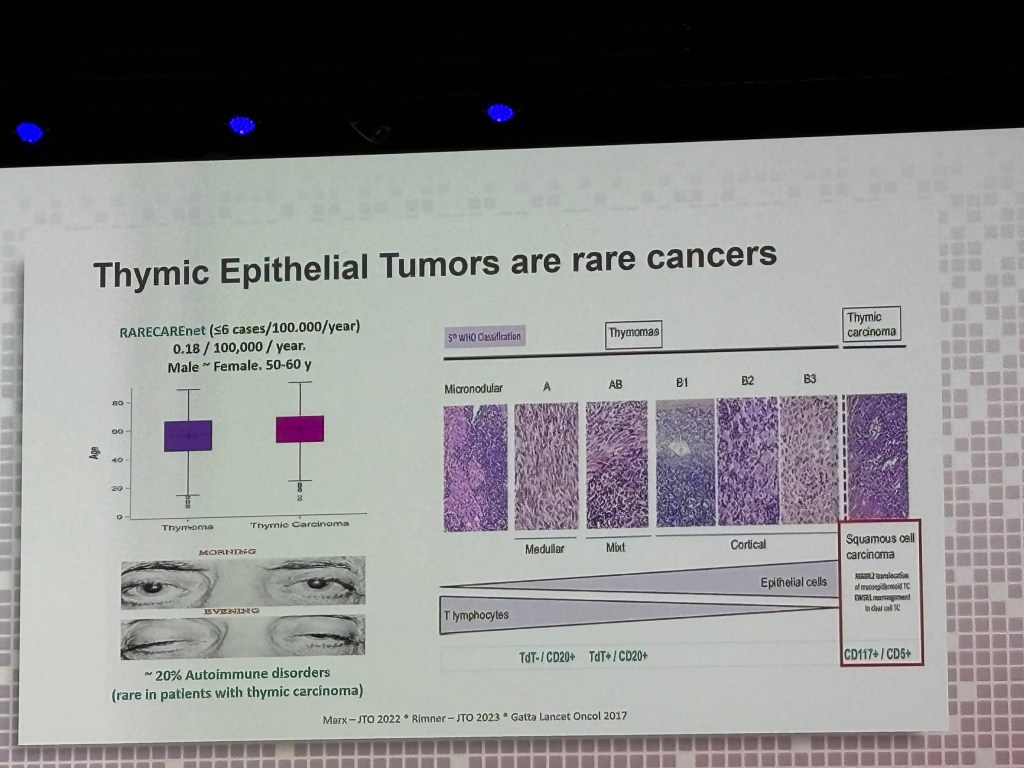
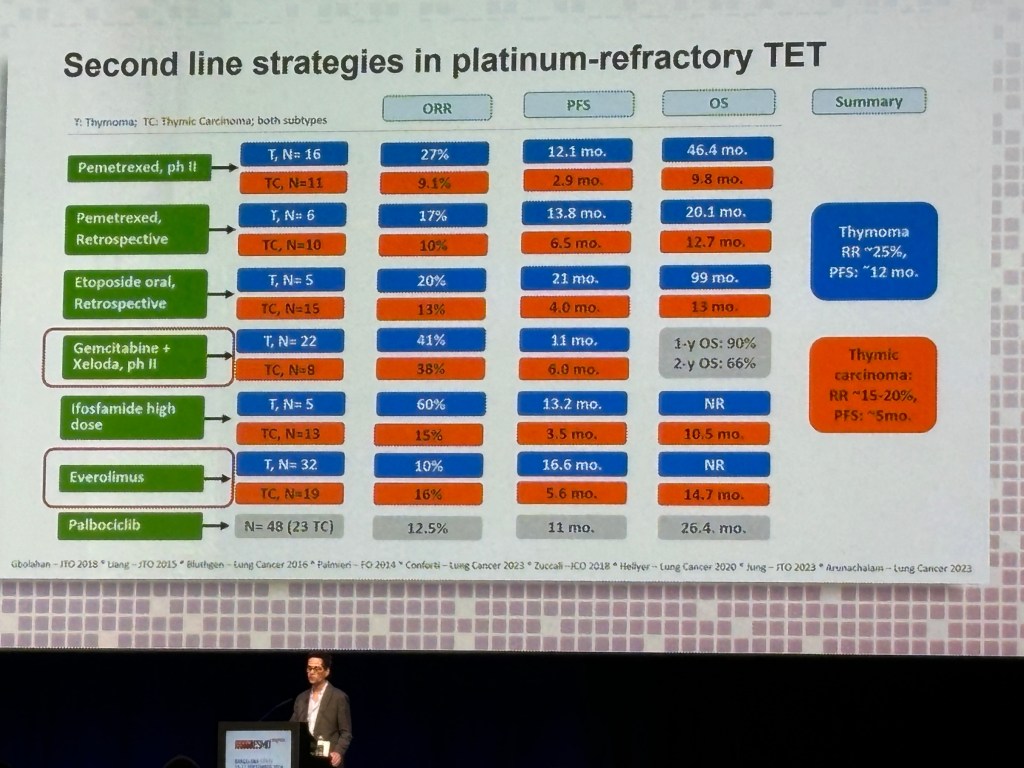
ESMO update on Thymus tumours

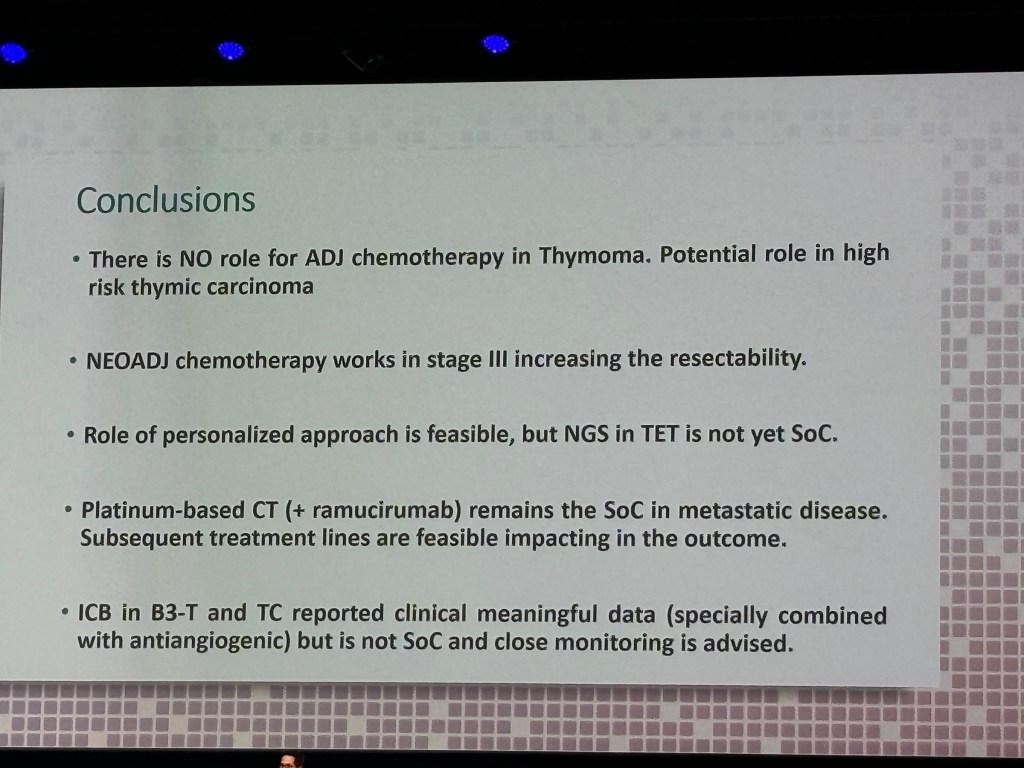
Tumours of Thymus are rare. So clinical data is usually spare. Hence they do not feature prominently in International conferences.

So it is interesting and a welcome gesture that ESMO dedicated a morning session to Thymic tumours. (ESMO European Society of Medical Oncology Congress-2024, Fira Barcelona).

Understandably, in a conference hall meant for thousands of delegates only a few hundreds turned up for the rare thymic tumours ( as delegates attended the 12 other massive halls with simultaneous sessions for common cancers such as prostate, breast , bowel etc).

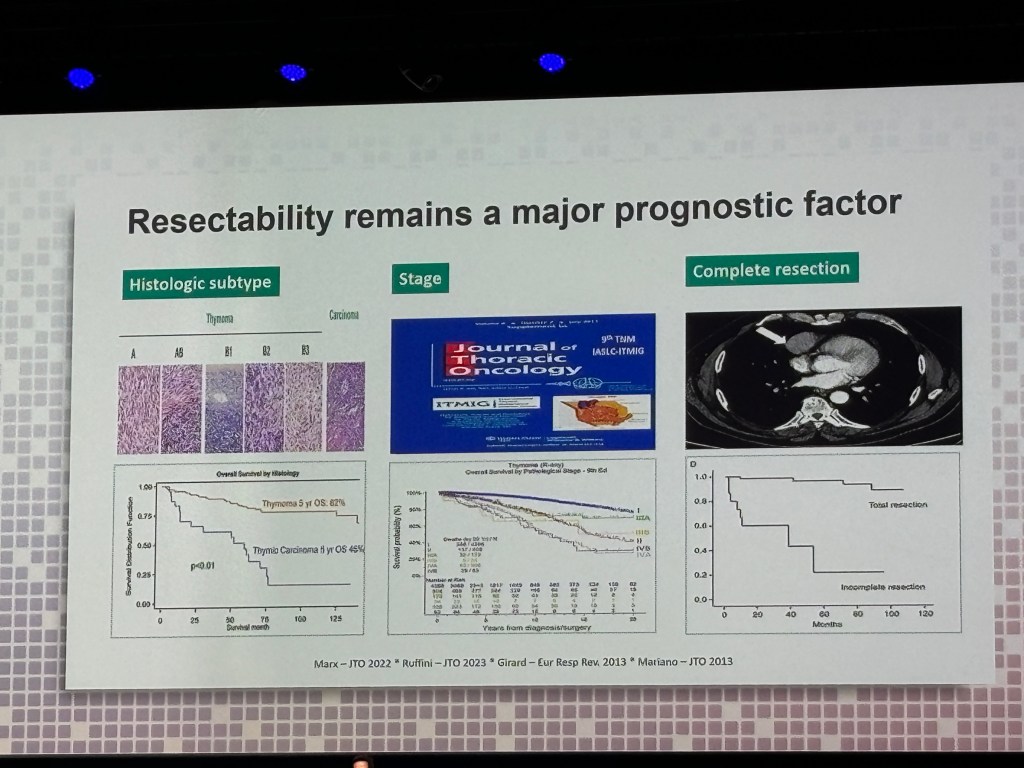
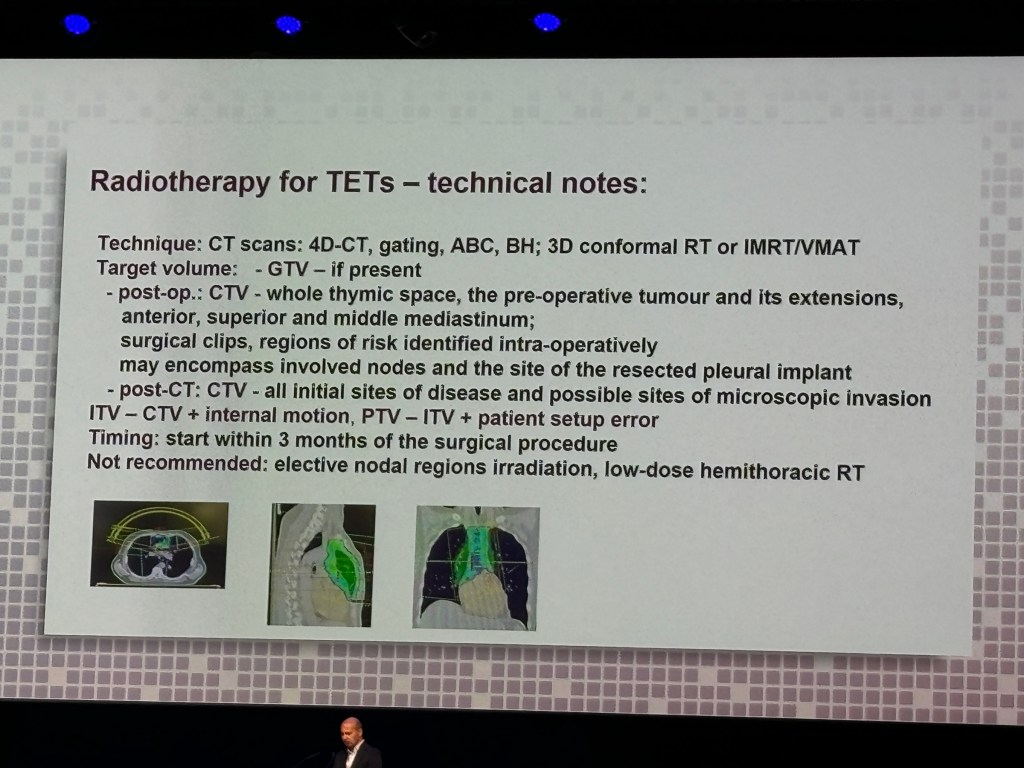
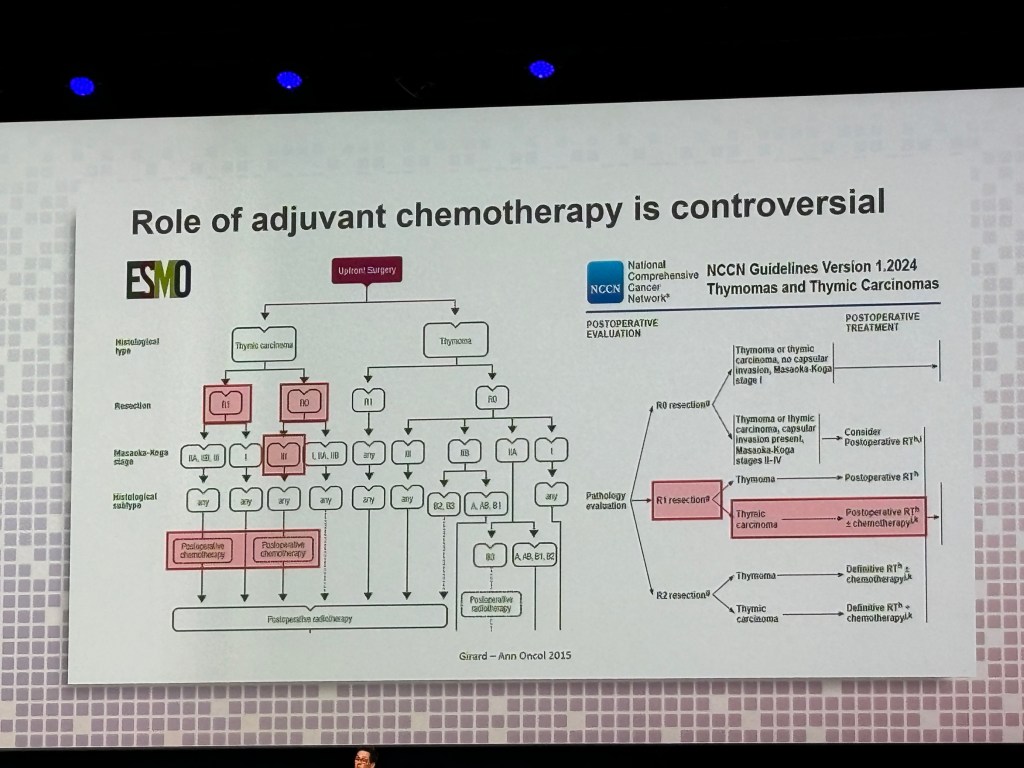
The relevant updates from this session are: 

  1. Surgical resection where feasible is the best treatment.
  2. in selected cases , post-operative radiotherapy can be considered 
  3. Routine adjuvant chemotherapy after complete surgical excision for early cancers is NOT indicated 
  4. Thymic cancers are chemo-sensitive and they have the potential to turn inoperable cancers to operable cancers.
  5. Platinum and Anthracycline combination chemo regimens have the best response rates.
  6. Immunotherapy and Molecular targeted therapy are possible options in those resistant to platinum drugs in addition to other non-platinum chemotherapy drugs .

Disclaimer: Please note – This blog is NOT medical advice. This blog is NOT a expert medical opinion on various topics. This blog is purely for information only and do check the sources where cited. Please DO consult your own doctor to discuss concerns and options relevant to you. The views expressed in this blog are NOT, in any way whatsoever, intended to be a substitute for professional advice. The blog is NOT previewed, commissioned or otherwise endorsed, in any way, by any organisation that the author is associated with. The views expressed in this blog likely represents some of the author’s personal views held at the time of drafting the blog and MAY CHANGE overtime, particularly when new evidence comes to light.
New drug for and 2nd and 3rd line treatment of Kidney cancer

Advanced Kidney cancer can be kept under control for long periods with current treatments.

Combination of immunotherapy and agents targeting VEGF are commonly used in 1st line treatment of advanced Kidney cancers.

For those patients who cancers stop responding to these above treatments, there is good news.

A new agent targeting cancers in a different way has become available recently and updated results are very encouraging.

This new drug called Belzutifan targets a different weak spot in the cancer. Belzutifan has shown better cancer control rates when compared to another drug called Everolimus.

Belzutifan results are being presented at ESMO congress in Barcelona

Belzutifan will become a standard of care in this setting now

Reference

ESMO news. Belzutifan Shows a Significant Benefit Over Everolimus in Patients with Advanced Clear Cell RCC After Both ICI and Antiangiogenic Therapies

NEJM Belzutifan versus Everolimus for Advanced Renal-Cell Carcinoma

Disclaimer: Please note – This blog is NOT medical advice. This blog is NOT a expert medical opinion on various topics. This blog is purely for information only and do check the sources where cited. Please DO consult your own doctor to discuss concerns and options relevant to you. The views expressed in this blog are NOT, in any way whatsoever, intended to be a substitute for professional advice. The blog is NOT previewed, commissioned or otherwise endorsed, in any way, by any organisation that the author is associated with. The views expressed in this blog likely represents some of the author’s personal views held at the time of drafting the blog and MAY CHANGE overtime, particularly when new evidence comes to light.

Anything potentially good from this COVID-19 pandemic?

It might seem foolish to ask the question “Anything good from this COVID-19 pandemic?” when so many people across the world has been so badly affected by the coronavirus pandemic.

There is some truth in the proverb that “every dark cloud has a silver lining” and no matter how bad the current pandemic is now, human spirit and endeavour would get something positive out of it.

One possible good thing that has come out of the pandemic is the “mRNA technology”.

Of the three vaccines so far, two of them the Pfizer vaccine and the Moderna vaccine are based on RNA technology.

The successful use of RNA technology for Coronavirus Vaccines would hopefully enable the versatile RNA technology to be further developed and successfully used a cancer treatment in near future.

Further clinical trials in cancer patients would be done to provide proof of their potential.

References:

Bloomberg. Technology & Ideas. mRNA Vaccines Could Vanquish Covid Today, Cancer Tomorrow.
The best news about the mRNA shots from BioNTech and Moderna is that the same technique could also defeat many other diseases.

MSKCC. In a Twist, Scientists Find Cancer Drivers Hiding in RNA, Not DNA.

Jerusalem Post Health & Science. Israeli scientists use mRNA COVID-19 vaccine technology to fight cancer. By MAAYAN JAFFE-HOFFMAN NOVEMBER 24, 2020 20:08

Disclaimer: Please note- This blog is NOT medical advice. This blog is purely for information only and do check the the sources where cited. Please DO consult your own doctor to discuss concerns and options relevant to you.

The views expressed in this blog represent the author’s views held at the time of drafting the blog and may change overtime, particularly when new evidence comes to light. The blog is not necessarily endorsed by any organisation the author is associated with and the authors views are not in way intended to be a substitute for professional advice.
New oral medication approved for Prostate Cancer

Advanced Prostate cancer can be successfully controlled for many years by hormone therapy.

Until now, the hormone therapy, which is widely used widely used, involved either hormone injections or hormone implants.

The FDA in USA has recently approved a new novel oral medication for prostate cancer. It acts quickly and has been proven to be highly active. It is taken as a daily oral medication. It is reasonably well tolerated.

It is not known when the medication would be approved in UK and Europe.

References

(1) NEJM. Oral Relugolix for Androgen-Deprivation Therapy in Advanced Prostate Cancer

(2) FDA approval. FDA approves relugolix for advanced prostate cancer.

(3) Information about Relugolix. FDA: HIGHLIGHTS OF PRESCRIBING INFORMATION. and FULL PRESCRIBING INFORMATION.

Disclaimer: Please note- This blog is NOT medical advice. This blog is purely for information only and do check the the sources where cited. Please DO consult your own doctor to discuss concerns and options relevant to you.

The views expressed in this blog represent the author’s views held at the time of drafting the blog and may change overtime, particularly when new evidence comes to light. The blog is not necessarily endorsed by any organisation the author is associated with and views are not substitute for professional advice.
Does intensive follow benefit Bowel cancer patients?

Photo by rawpixel.com on Pexels.com

The old adage “prevention is better than cure” is mostly true with regards to cancer if you can do it.

If you can’t prevent it , at least catch it early, has been the prime motive behind screening tests for breast, cervical, bowel, lung and prostate cancers. (“early is better”). Cancers that are detected at an early stage can offer a better chance of curative treatment.

So one might logically expect that intensive monitoring and early diagnosis of a cancer relapse or a secondary cancer after initial treatment can be immensely helpful.

But the evidence for intensive hospital follow-up visits and investigations is weak for most cancers except for some cancers such as Testicular Cancers which are highly curable.

Intensive monitoring after bowel cancer treatment can detect treatable cancers. To confirm the benefit of early detection of relapse by intensive monitoring , a trial was conducted comparing intensive follow up versus routine follow up ( in France and Belgium).

Data presented at ESMO ( European Society of Medical Oncology) shows that the intensive follow with scans can detect cancer recurrences which can be treated by further surgery. But unfortunately the intensive follow up did NOT lead to longer life expectancy.

The results might be counterintuitive but after an average follow up more than six years, this trial demonstrates that intensive follow is NOT always best. Scans might be done for psychological reassurance but they could end up causing significant anxiety.

When there are resource constraints (e.g low economic countries) , one has to be careful about frequents routine scans for those without symptoms.

During COVID-19, even in rich countries such as UK where there might be huge waiting lists, one has to consider prioritising scans for those who need most.

References

1. ESMO Daily reporter: INTENSIVE FOLLOW-UP INCREASES FREQUENCY OF CURATIVE INTENT SECONDARY SURGERY IN COLORECTAL CANCER.

2. DRE is useless for follow up of prostate cancer patients. https://www.bmj.com/rapid-response/2011/11/03/dre-useless-follow-prostate-cancer-patients

3. Cancer patients follow up and a new role for GPs. https://www.bmj.com/rapid-response/2011/11/03/cancer-patients-follow-and-new-role-gps

Disclaimer: Please note- This blog is NOT medical advice. This blog is purely for information only and do check the the sources where cited. Please consult your own doctor to discuss concerns and options relevant to you.

The views expressed in this blog represent the author’s views held at the time of drafting the blog and is likely to change overtime, particularly when new evidence comes to light. The blog is not necessarily endorsed by any organisation the author is associated with and views are not substitute for professional advice.

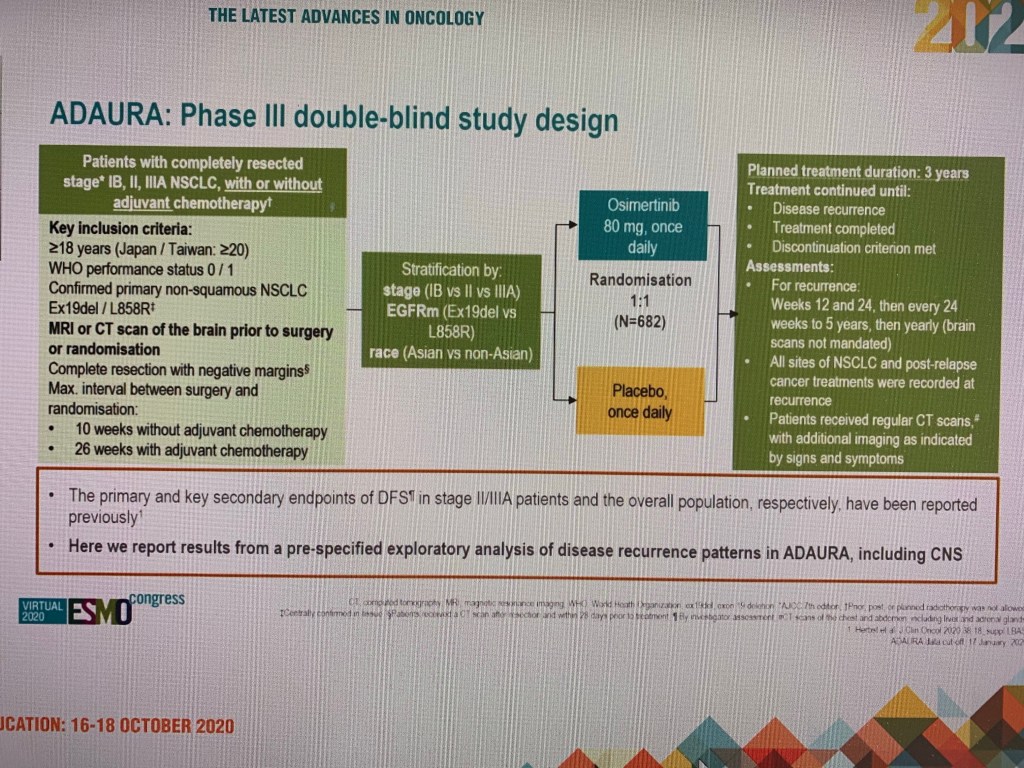
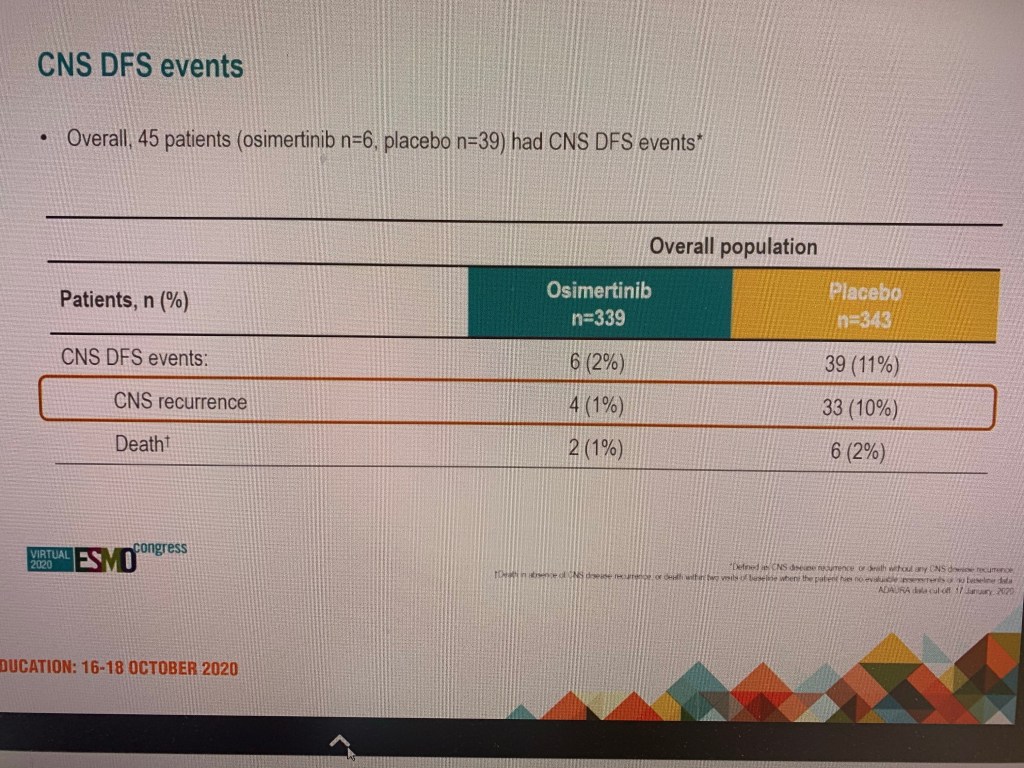
A novel drug Osimertinib reduces risk of Brain cancer secondaries in lung cancer patients

Traditional intravenous Chemotherapy agents are often thought NOT to be highly effective in treating and preventing brain secondaries. This is because of the penal blood brain barrier.

Data presented at ESMO ( European Society of Medical Oncology) presidential symposium shows that the Osimertinib is highly active and significantly reduces risk of brain secondaries.

Disclaimer: Please note- This blog is NOT medical advice. This blog is purely for information only and do check the the sources where cited. Please consult your own doctor to discuss concerns and options relevant to you.

The views expressed in this blog represent the author’s views held at the time of drafting the blog and is likely to change overtime, particularly when new evidence comes to light. The blog is not necessarily endorsed by any organisation the author is associated with and views are not substitute for professional advice.
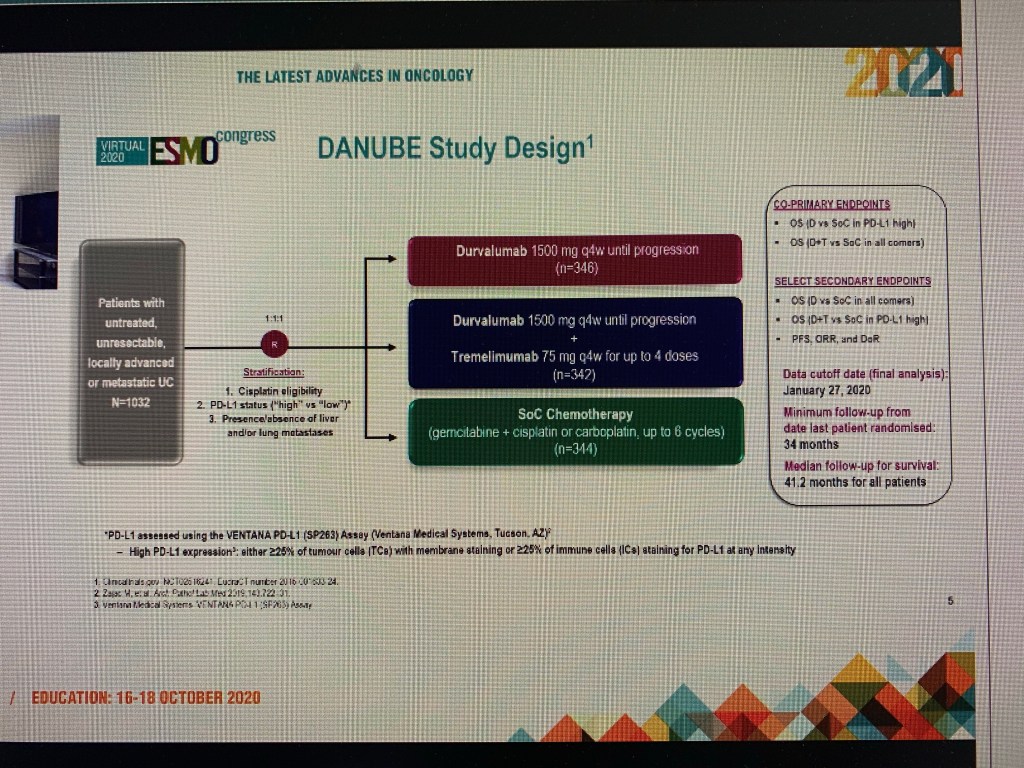
Immunotherapy not superior to Chemotherapy in 1st line treatment of bladder cancer

Immunotherapy has revolutionised the treatment of many advanced cancers such Skin cancer Melanoma and Kidney cancers.

Immunotherapy is a standard treatment for 2nd line treatment of bladder cancer.

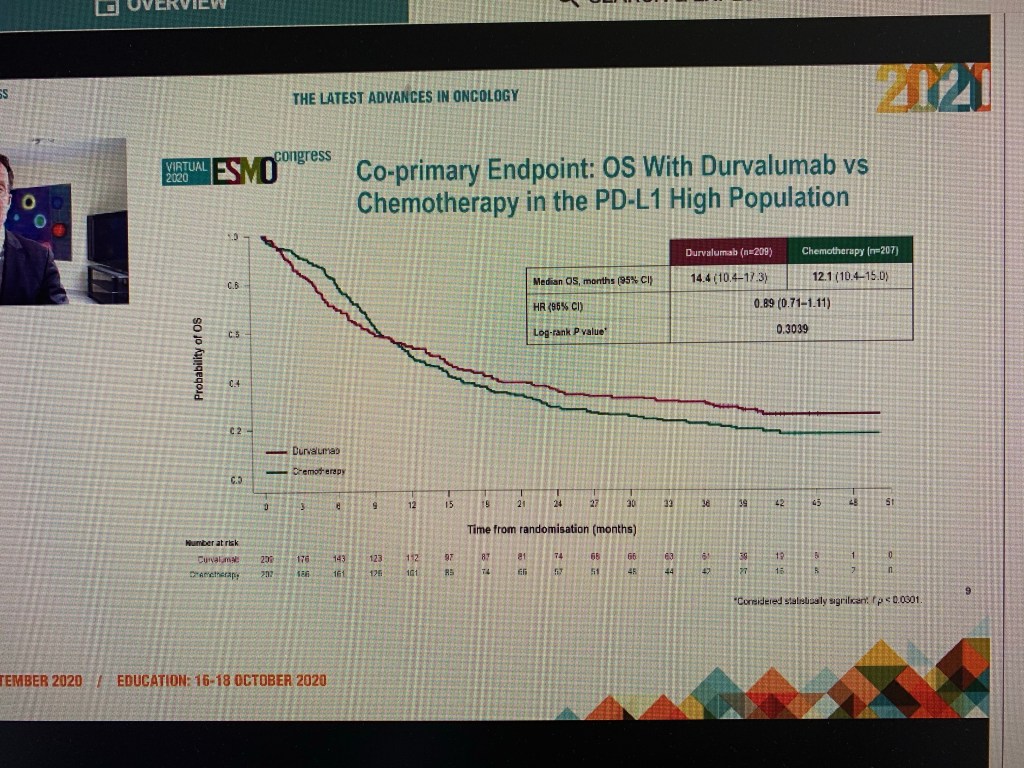
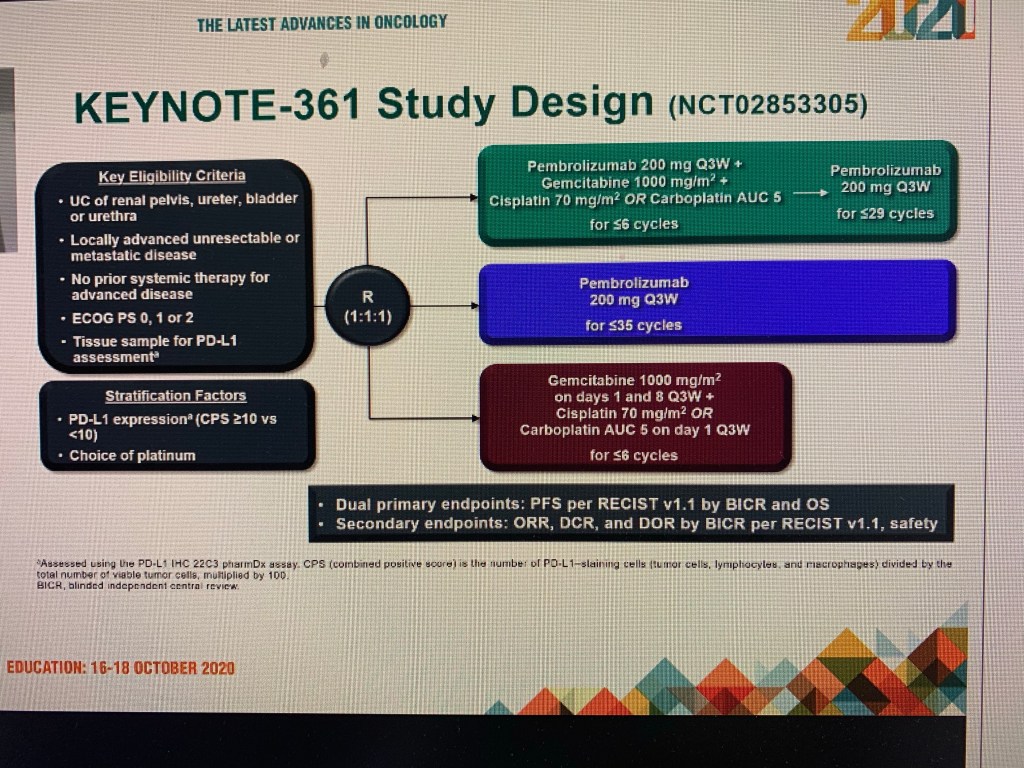
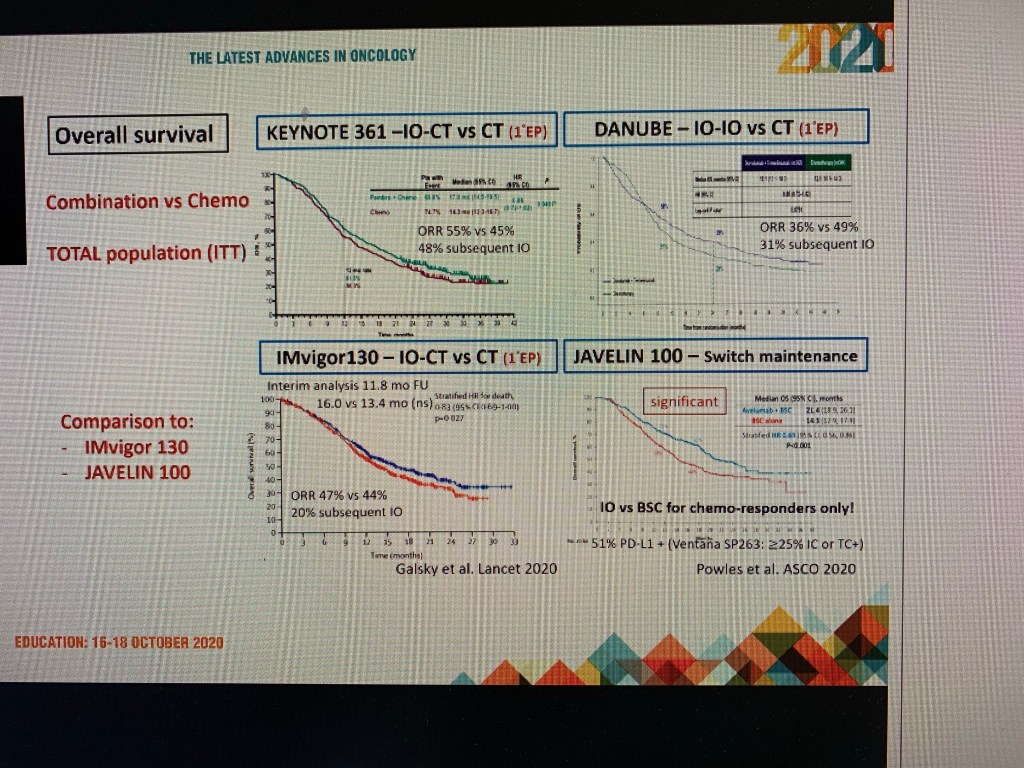
Two recent trials presented at ESMO virtual meeting explored the use of immunotherapy in 1st line setting. (Pembrolizumab and Durvalumab).

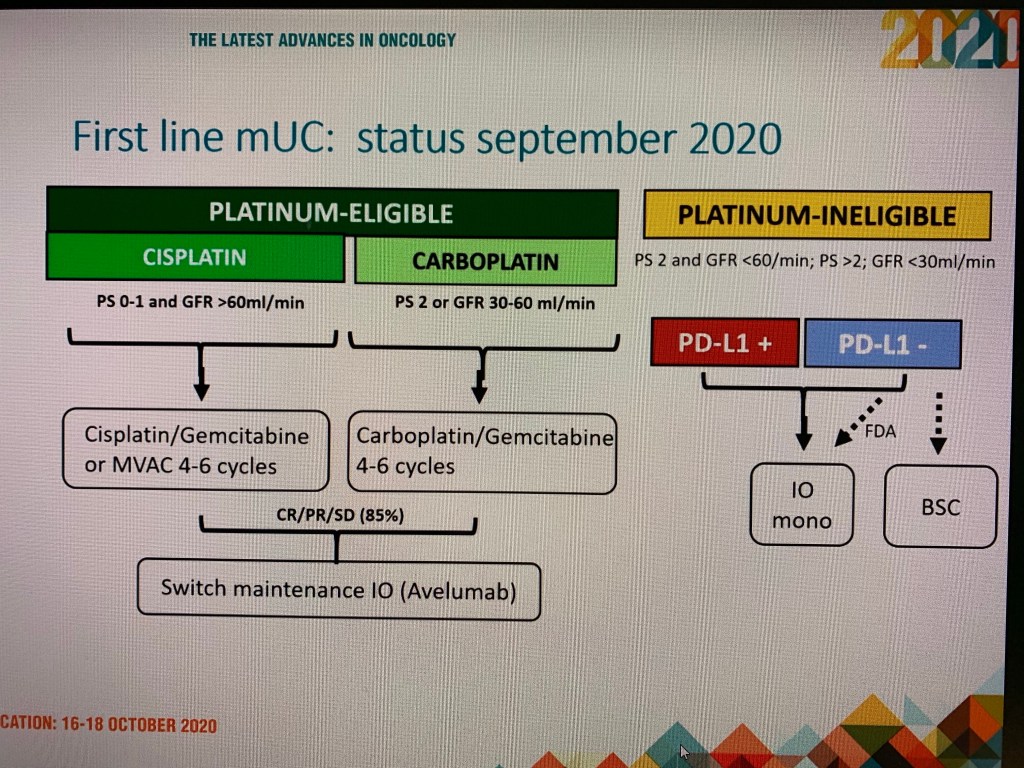
Immunotherapy alone, or in combination with Chemotherapy was not superior even in patients selected by markers thought to favour immunotherapy alone.

For most bladder cancer patients immunotherapy remains a excellent 2nd line option or as a maintenance treatment option.

Disclaimer: Please note- This blog is NOT medical advice. This blog is purely for information only and do check the the sources where cited. Please consult your own doctor to discuss concerns and options relevant to you. The views expressed in this blog represent the author’s views held at the time of drafting the blog and is likely to change overtime, particularly when new evidence comes to light. The blog is not necessarily endorsed by any organisation the author is associated with and views are not substitute for professional advice.
New treatment for Advanced Uterine Cancer

Women with advanced uterine / endometrial cancer are usually treated with chemotherapy.

Those who failed chemotherapy or those who are fit for chemotherapy are sometimes treated with hormone treatment.

Letrozole is one such hormone treatment for those patients with hormone sensitive cancer.

In breast cancer, Letrozole efficacy can be improved by a treatment called Palboclicib.

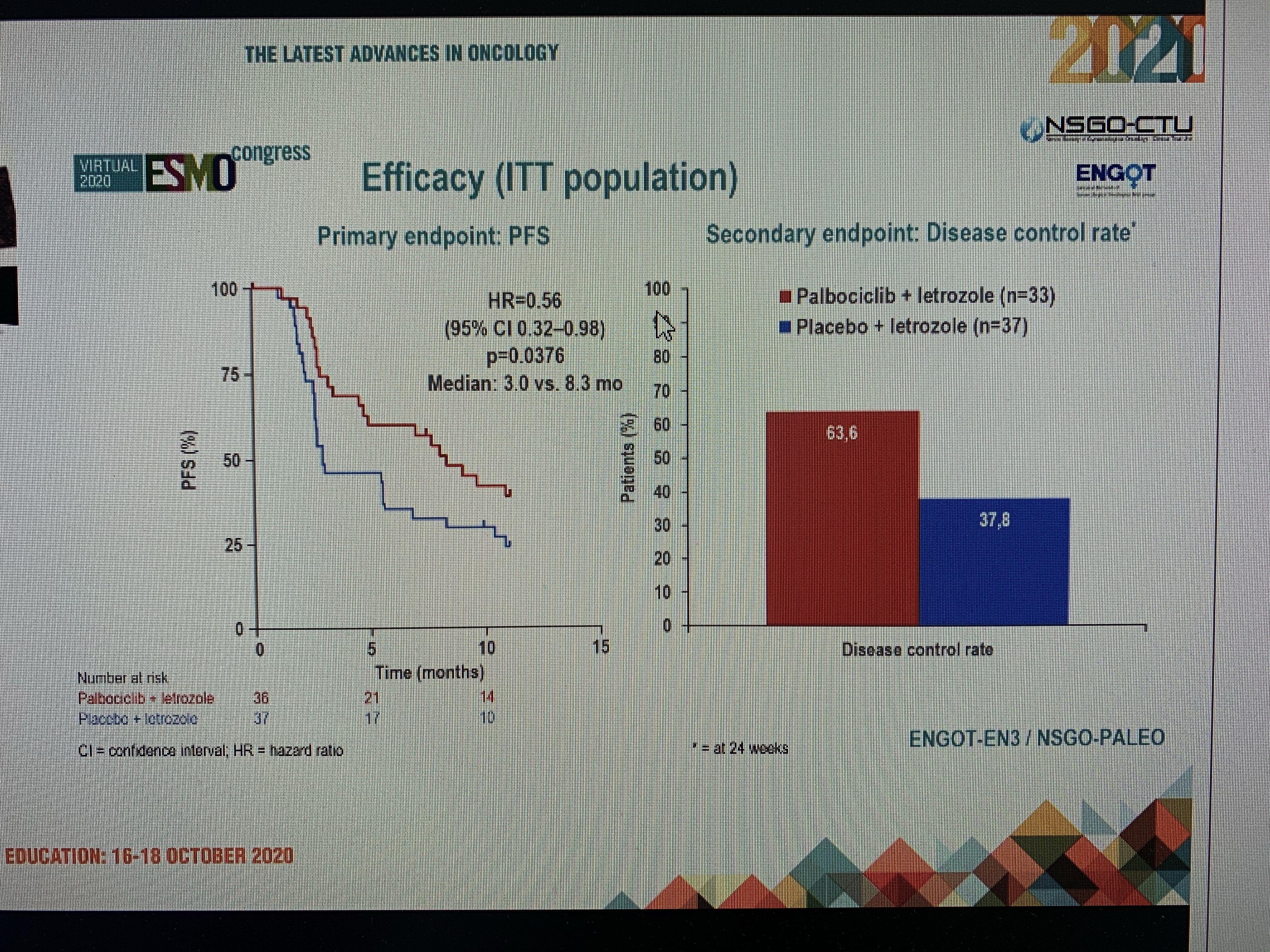
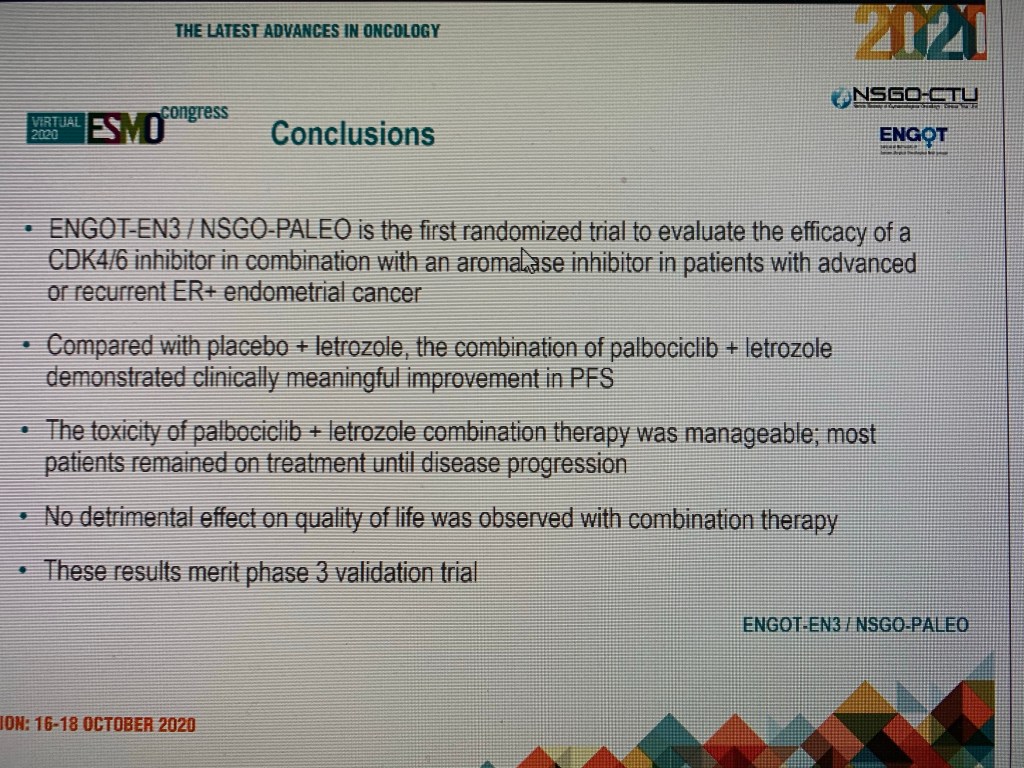
A trial was done to check whether the same improvement can be observed in uterine cancer when the combination of Letrozole and Palboclicib is tried.

The trial data presented at the ESMO ( European Society of Medical Oncology) is very promising.

If large trials confirm this finding, the combination would be standard treatment in future.

Disclaimer: Please note- This blog is NOT medical advice. This blog is purely for information only and do check the the sources where cited. Please consult your own doctor to discuss concerns and options relevant to you.

The views expressed in this blog represent the author’s views held at the time of drafting the blog and is likely to change overtime, particularly when new evidence comes to light. The blog is not necessarily endorsed by any organisation the author is associated with and views are not substitute for professional advice.