
Immunotherapy for curative treatment of Cervical cancer

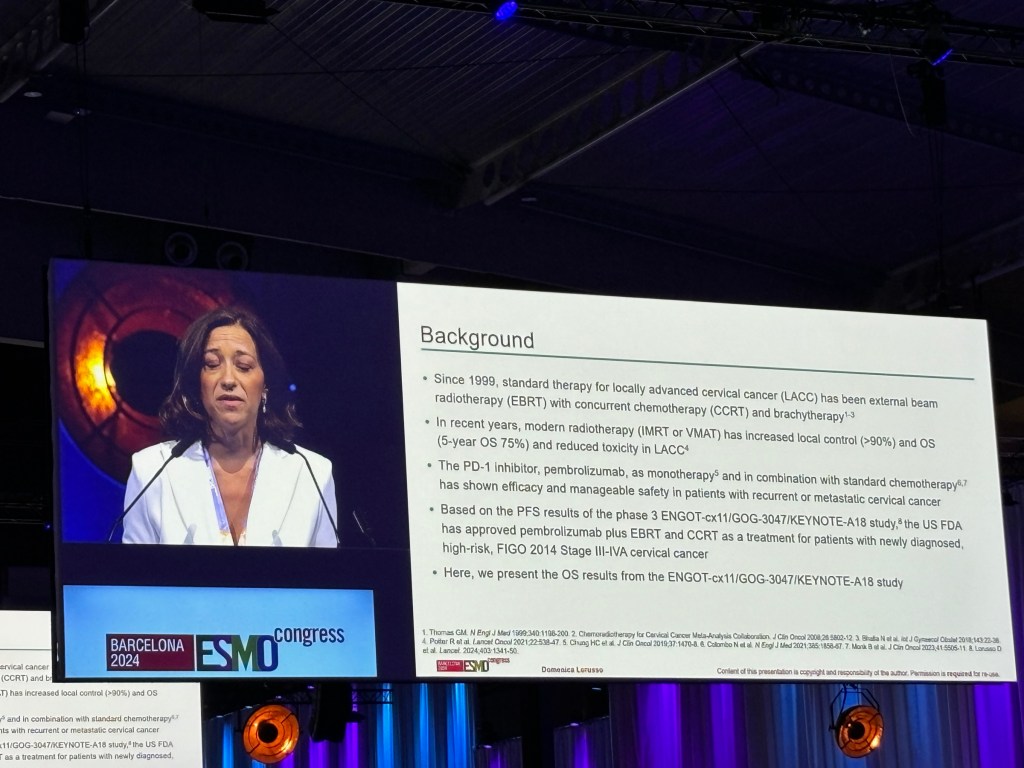
Updated Data presented at the ESMO Congress 2024( Barcelona, 13–17 September) confirms benefit of adding immunotherapy to combination of chemotherapy and radiotherapy for treatment of cervical cancer.

For nearly twenty years, chemo- radiation, which is the practice of giving chemotherapy at the same time as radiotherapy, was the standard of care.

Last year, early results from a large trial suggested that adding immunotherapy to chemo-radiation would improve outcome .

Updated results confirm that the additional immunotherapy is of significant benefit.
Reference

Lancet. Pembrolizumab or placebo with chemoradiotherapy followed by pembrolizumab or placebo for newly diagnosed, high-risk, locally advanced cervical cancer (ENGOT-cx11/GOG-3047/KEYNOTE-A18): overall survival results from a randomised, double-blind, placebo-controlled, phase 3 trial.

Disclaimer: Please note – This blog is NOT medical advice. This blog is NOT a expert medical opinion on various topics. This blog is purely for information only and do check the sources where cited. Please DO consult your own doctor to discuss concerns and options relevant to you. The views expressed in this blog are NOT, in any way whatsoever, intended to be a substitute for professional advice. The blog is NOT previewed, commissioned or otherwise endorsed, in any way, by any organisation that the author is associated with. The views expressed in this blog likely represents some of the author’s personal views held at the time of drafting the blog and MAY CHANGE overtime, particularly when new evidence comes to light.

Why advanced cancer patients choose to have chemotherapy!

Many people would be surprised to learn that cancer patients with advanced incurable cancer actively choose chemotherapy for relatively small benefits.

Chemotherapy has the potential to relieve cancer related symptoms but in many advanced cancers, Chemotherapy prolongs survival ( on average ) only by a few months . Yet, lot of patients do opt to try chemotherapy which can be sometimes quite toxic.

Even in countries such as U.K. where oncologists are NOT on a fee for service contract (such as NHS), lot of patients do opt for Chemotherapy.

Perhaps, Chemotherapy gives hope for people not ready to face death.

Read my views in BMJ and contribute your thoughts on this topic through the rapid response section of online BMJ.

BMJ Article: Death, futility, and oncology

Free to access link: http://bmj.com/cgi/content/full/bmj.o1785?ijkey=Du1yaSA5KhkGz23&keytype=ref

Disclaimer: Please note – This blog is NOT medical advice. This blog is NOT a expert medical opinion on various topics. This blog is purely for information only and do check the sources where cited. Please DO consult your own doctor to discuss concerns and options relevant to you. The views expressed in this blog are NOT, in any way whatsoever, intended to be a substitute for professional advice. The blog is NOT previewed, commissioned or otherwise endorsed, in any way, by any organisation that the author is associated with. The views expressed in this blog likely represents some of the author’s personal views held at the time of drafting the blog and MAY CHANGE overtime, particularly when new evidence comes to light.

Immunotherapy improves survival of patients with Advanced Cervical cancer

Advanced Cervical cancer, that cannot be cured by surgery or radiotherpy, is usually treated with chemotherapy.

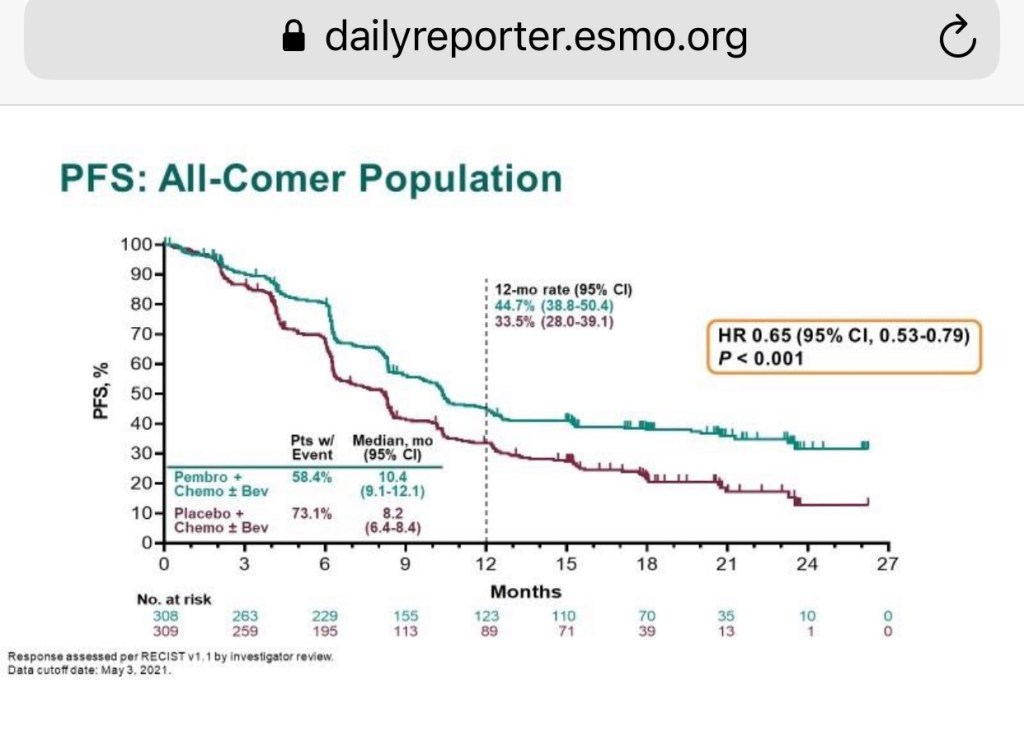
A study assessed the effectiveness of immunotherapy in combination with standard chemotherapy.

The results were presented at the ESMO (European Medical Oncology Conference) on 18th Sept 2021.

The combination of immunotherapy and chemotherapy is remarkably better and makes patients live longer.

This is likely to become the standard of care now.

References

Presidential Symposium 1 (ESMO Congress 2021). KEYNOTE-826 trial met its dual primary endpoints.

Disclaimer: Please note – This blog is NOT medical advice. This blog is NOT a expert medical opinion on various topics. This blog is purely for information only and do check the sources where cited. Please DO consult your own doctor to discuss concerns and options relevant to you. The views expressed in this blog are NOT, in way whatsoever, intended to be a substitute for professional advice. The blog is NOT previewed, commissioned or otherwise endorsed, in any way, by any organisation that the author is associated with. The views expressed in this blog likely represents some of the author’s personal views held at the time of drafting the blog and MAY CHANGE overtime, particularly when new evidence comes to light.
New treatment for Cervical cancer

Advanced Cervical cancer which has come back after surgery or radiotherpy is usually treated with chemotherapy.

There is a new immunotherapy treatment option for all advanced cervical cancer patients now .

At the European Society of Medical Oncology (ESMO 2021) virtual conference, an international team of investigators, presented trial data regarding this new immunotherapy drug called cemiplimab.

One group of patients in the trial received the immunotherapy drug cemiplimab every 3 wks and another group of patients received intravenous chemo (pemetrexed, vinorelbine, gemcitabine, irinotecan or topotecan).

Cemiplimab significantly improved survival of patients and was better than chemotherapy.

This new immunotherapy drug cemiplimab is already being used for skin cancers and vulval skin cancers. Very soon, it would be used in cervical cancer patients.

Reference

ESMO 2022 Virtual Plenary Resources:
RANDOMISED PHASE III TRIAL DATA ON THE EFFICACY AND SAFETY OF CEMIPLIMAB AS OPPOSED TO CHEMOTHERAPY IN PATIENTS WITH PROGRESSIVE ADVANCED CERVICAL CANCER. Presenter: Krishnansu S. Tewari, USA; Discussant: Mansoor Mirza, Denmark;

Disclaimer: Please note- This blog is NOT medical advice. This blog is NOT a expert medical opinion on various topics. This blog is purely for information only and do check the the sources where cited. Please DO consult your own doctor to discuss concerns and options relevant to you. The views expressed in this blog represent the author’s views held at the time of drafting the blog and may change overtime, particularly when new evidence comes to light. The blog is not previewed, commissioned or otherwise endorsed by any organisation the author is associated with. The views expressed in this blog are not in way intended to be a substitute for professional advice.