Can applying some electric current make chemotherapy work better in pancreatic cancer ?

Yes !

Applying electricity to tumours can help to improve control of pancreatic cancer.

The procedure is called TTfFields.

The procedure is not invasive.

The procedure uses low-energy electricity which impedes cancer cells’ ability to grow and divide.

The procedure is done alongside standard chemotherapy .

The TTFields electric treatments has already been tested and has shown promise in brain tumours and lung cancers.

A study presented at the Chicago ASCO meeting shows better survival in patients who had TTFields electricity in addition to their usual chemotherapy regimen of gemcitabine and abraxane (nab-paclitaxel) for pancreatic cancer.

The study data was presented at the prestigious annual meeting of the American Society of Clinical Oncology (ASCO) at Chicago.

Dr Sundar is a member of American Society of Clinical Oncology (ASCO) and has been a member for more than 25 years.

References

  1. Tumour treating fields therapy for glioblastoma: current advances and future directions. British Journal of Cancer volume 124, pages 697–709 (2021)
  2. Weinberg U, Farber O, Giladi M, Bomzon Z, Kirson ED. Tumor treating field concurrent with standard of care for stage 4 non-small cell lung cancer (NSCLC) following platinum failure: Phase III LUNAR study. [abstract]. ESMO, October 2018. Ann Oncol. 2018;29:viii543. doi: 10.1093/annonc/mdy292.120.
  3. Lancet oncology. Tumor Treating Fields therapy with standard systemic therapy versus standard systemic therapy alone in metastatic non-small-cell lung cancer following progression on or after platinum-based therapy (LUNAR): a randomised, open-label, pivotal phase 3 study.
  4. Wiki. Alternating electric field therapy.
  5. PANOVA-3: Phase 3 study of tumor treating fields (TTFields) with gemcitabine and nab-paclitaxel for locally advanced pancreatic ductal adenocarcinoma (LA-PAC) .
Disclaimer: Please note – This blog is NOT medical advice. This blog is NOT a expert medical opinion on various topics. This blog is purely for information research only and do check the sources where cited. Please DO consult your own doctor to discuss concerns and options, which are relevant and specific to you. The views expressed in this blog are NOT, in any way whatsoever, intended to be a substitute for professional advice. The blog is NOT previewed, commissioned or otherwise endorsed, in any way, by any organisation that the author is associated with. The views expressed in this blog likely represents some of the author’s personal views held at the time of drafting the blog and MAY CHANGE overtime, particularly when new evidence comes to light.


More pancreatic cancer patients may benefit from immunotherapy

Immunotherapy has revolutionised cancer treatment over the last few years . But, sadly, not all cancer patients derive benefit from the costly immunotherapy drugs

For instance, almost, all advanced kidney or skin melanoma cancer patients are eligible to try immunotherapy. But only about 1% of patients with pancreatic cancer are at present eligible for immunotherapy .

A new study suggests more people with pancreatic cancer may be eligible for immunotherapy. 

The preliminary data from a good quality early study (randomized phase II trial) is interesting.

The study compared treatment with gemcitabine (G) and nab-paclitaxel (N) with and without dual immunotherapy treatment with durvalumab (D) and tremelimumab (T) as 1st-line therapy in patients with advanced pancreatic cancer. 

In this study, only a subset of patients derived benefit from the dual combination therapy. 

Subsequent molecular and genetic analysis showed that the presence of certain gene mutations (≥2 DDR) was strongly associated with benefit from the combination of chemotherapy with dual immune checkpoint inhibitor therapy. 

These intriguing exploratory data analysis needs confirmatory data before the combination therapy become the standard of care for advanced pancreatic cancer patients.

The study data was presented at the prestigious annual meeting of the American Society of Clinical Oncology (ASCO) hosted at Chicago.

Dr Sundar is a member of American Society of Clinical Oncology (ASCO) and has been a member for more than 25 years.

References

American Society of Clinical Oncology (ASCO) 2025: Concurrent mutations in DNA damage repair genes BRCA1, POLE, ATM and FANCA to predict overall and progression-free survival for patients (pts) with metastatic pancreatic ductal adenocarcinoma (mPDAC) treated with chemotherapy in combination with dual checkpoint inhibition in the CCTG randomized PA.7 trial.

Evaluating Mismatch Repair Deficiency in Pancreatic Adenocarcinoma: Challenges and Recommendations. Clin Cancer Res (2018) 24 (6): 1326–1336.

Disclaimer: Please note – This blog is NOT medical advice. This blog is NOT a expert medical opinion on various topics. This blog is purely for information research only and do check the sources where cited. Please DO consult your own doctor to discuss concerns and options, which are relevant and specific to you. The views expressed in this blog are NOT, in any way whatsoever, intended to be a substitute for professional advice. The blog is NOT previewed, commissioned or otherwise endorsed, in any way, by any organisation that the author is associated with. The views expressed in this blog likely represents some of the author’s personal views held at the time of drafting the blog and MAY CHANGE overtime, particularly when new evidence comes to light.

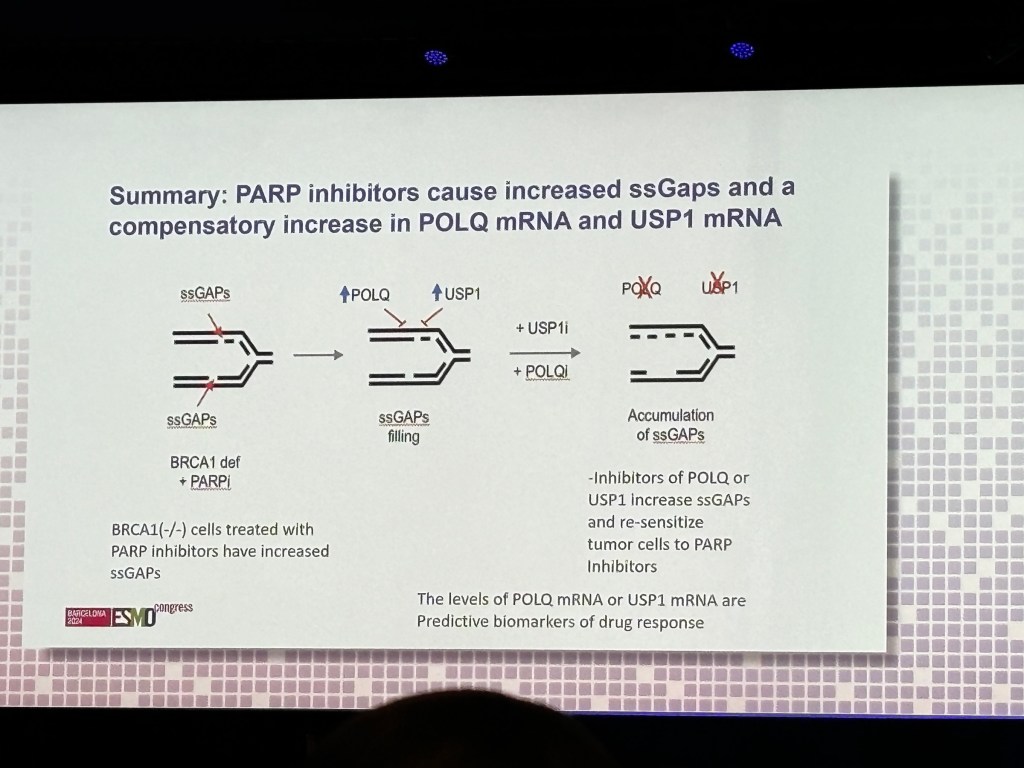
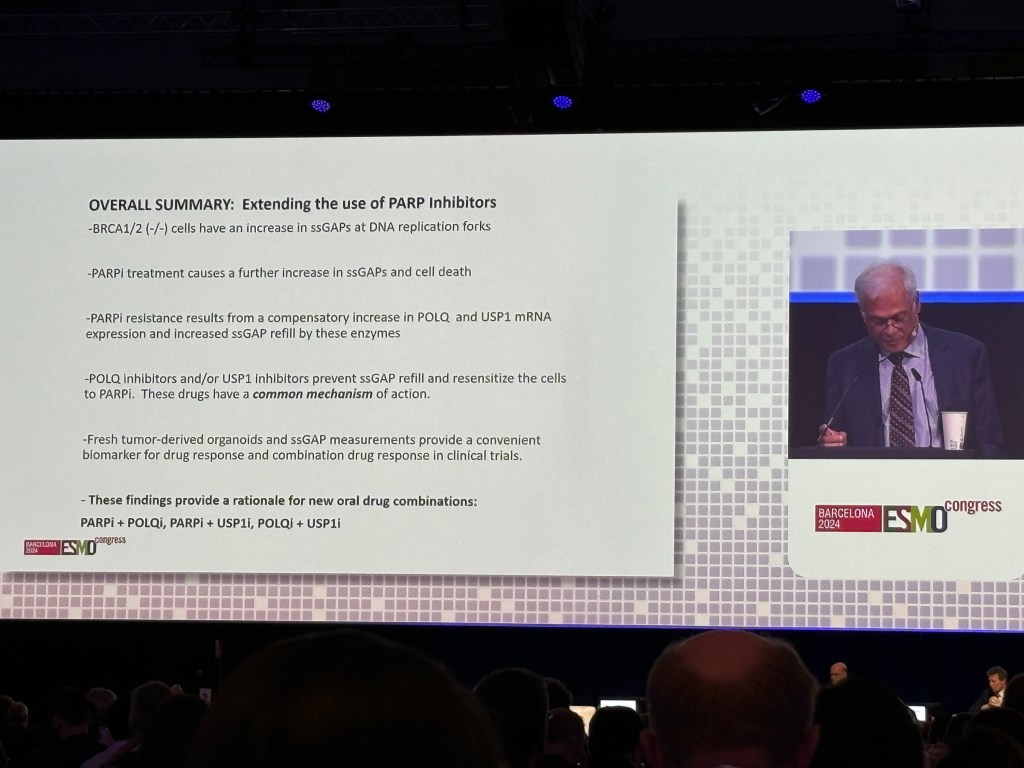
How to overcome resistance to Olaparib and other similar PARP inhibitors ?

Olaparib and similar drugs have revolutionised the treatment of a sub-set of patients with BRCA gene mutations ( eg Ovarian, Prostate, Breast cancers).

But patients can develop resistance to these drugs.

At the ESMO European Society of Medical Oncology Congress-2024, Barcelona), ways to overcome this resistance was discussed.

Targeting the Enzymes USP-1 and POLQ seems to overcome resistance.

The future looks promising!

Disclaimer: Please note – This blog is NOT medical advice. This blog is NOT a expert medical opinion on various topics. This blog is purely for information only and do check the sources where cited. Please DO consult your own doctor to discuss concerns and options relevant to you. The views expressed in this blog are NOT, in any way whatsoever, intended to be a substitute for professional advice. The blog is NOT previewed, commissioned or otherwise endorsed, in any way, by any organisation that the author is associated with. The views expressed in this blog likely represents some of the author’s personal views held at the time of drafting the blog and MAY CHANGE overtime, particularly when new evidence comes to light.
Milder chemotherapy for older patients with pancreatic cancer

Older adults with newly diagnosed advanced pancreatic cancer are often frail and vulnerable.

The standard chemotherapy regimens such as the FOLFIRINOX regimen are quite toxic and not suitable for frail patients.

At the recent ASCO meeting in Chicago, a study which utilised gentler versions of the existing chemotherapy regimens was presented.

These gentler versions were found to have reasonable efficacy and toxicity.

References

1. ASCO post. Efrat Dotan, MD, on Pancreatic Cancer in Older Adults: Defining the Optimal Treatment Approach.

2. ASCO 2024 Abstract. A randomized phase II study of gemcitabine and nab-paclitaxel compared with 5-fluorouracil, leucovorin, and liposomal irinotecan in older patients with treatment-naïve metastatic pancreatic cancer (GIANT): ECOG-ACRIN EA2186.

Disclaimer: Please note – This blog is NOT medical advice. This blog is NOT a expert medical opinion on various topics. This blog is purely for information only and do check the sources where cited. Please DO consult your own doctor to discuss concerns and options relevant to you. The views expressed in this blog are NOT, in any way whatsoever, intended to be a substitute for professional advice. The blog is NOT previewed, commissioned or otherwise endorsed, in any way, by any organisation that the author is associated with. The views expressed in this blog likely represents some of the author’s personal views held at the time of drafting the blog and MAY CHANGE overtime, particularly when new evidence comes to light.
Why advanced cancer patients choose to have chemotherapy!

Many people would be surprised to learn that cancer patients with advanced incurable cancer actively choose chemotherapy for relatively small benefits.

Chemotherapy has the potential to relieve cancer related symptoms but in many advanced cancers, Chemotherapy prolongs survival ( on average ) only by a few months . Yet, lot of patients do opt to try chemotherapy which can be sometimes quite toxic.

Even in countries such as U.K. where oncologists are NOT on a fee for service contract (such as NHS), lot of patients do opt for Chemotherapy.

Perhaps, Chemotherapy gives hope for people not ready to face death.

Read my views in BMJ and contribute your thoughts on this topic through the rapid response section of online BMJ.

BMJ Article: Death, futility, and oncology

Free to access link: http://bmj.com/cgi/content/full/bmj.o1785?ijkey=Du1yaSA5KhkGz23&keytype=ref

Disclaimer: Please note – This blog is NOT medical advice. This blog is NOT a expert medical opinion on various topics. This blog is purely for information only and do check the sources where cited. Please DO consult your own doctor to discuss concerns and options relevant to you. The views expressed in this blog are NOT, in any way whatsoever, intended to be a substitute for professional advice. The blog is NOT previewed, commissioned or otherwise endorsed, in any way, by any organisation that the author is associated with. The views expressed in this blog likely represents some of the author’s personal views held at the time of drafting the blog and MAY CHANGE overtime, particularly when new evidence comes to light.

Galleri cancer test: an exciting new test for cancer

Galleri test is a new type of blood test for cancer. The test promises to revolutionise cancer diagnosis.

Trials have started in UK to see how well the test works in real world.

Within a few years, we should be able to see early results.

Just because a cancer can be diagnosed early, it does not automatically mean that it will make patients live longer.

Let’s say, a person is diagnosed with a serious cancer at age of 60 yrs and dies of cancer at age of 65 yrs.

Any test that detects the cancer early ( before the age of 60) should make this person live longer than 65 years.

If the test , for example, detects the cancer at the age of 55 instead of 60, but the person still dies of cancer at 65, then it is a worthless test.

Hopefully, the trial will thoroughly analyse the outcome to see whether the test is of overall benefit.

References

Galleri™ Test

NHS launches world first trial for new cancer test. 13 September 2021

BBC news. Galleri cancer test: What is it and who can get it? 13 Sept 2021

Disclaimer: Please note – This blog is NOT medical advice. This blog is NOT a expert medical opinion on various topics. This blog is purely for information only and do check the sources where cited. Please DO consult your own doctor to discuss concerns and options relevant to you. The views expressed in this blog are NOT, in way whatsoever, intended to be a substitute for professional advice. The blog is NOT previewed, commissioned or otherwise endorsed, in any way, by any organisation that the author is associated with. The views expressed in this blog likely represents some of the author’s personal views held at the time of drafting the blog and MAY CHANGE overtime, particularly when new evidence comes to light.