This year’s ESMO 2023 Conference had breaking news for lot of new drugs in various cancers.
One such drug called Amivantamab is very promising in 1st line as well as 2nd line setting, both in combination with chemotherapy as well as in combination with a new oral drug called lazertinib.
Disclaimer: Please note – This blog is NOT medical advice. This blog is NOT a expert medical opinion on various topics. This blog is purely for information only and do check the sources where cited. Please DO consult your own doctor to discuss concerns and options relevant to you. The views expressed in this blog are NOT, in any way whatsoever, intended to be a substitute for professional advice. The blog is NOT previewed, commissioned or otherwise endorsed, in any way, by any organisation that the author is associated with. The views expressed in this blog likely represents some of the author’s personal views held at the time of drafting the blog and MAY CHANGE overtime, particularly when new evidence comes to light.
Datopotamab Deruxtecan is a new drug which is known in shorter version as Dato Dxd.
Dato Dxd is very promising in breast cancer and Lung cancers that have failed to respond to prior treatments
Dato Dxd belongs a existing new group of cancer drugs known ADCs ( Antibody drug Conjugate).
ADCs involve a combination of carrier molecule and a payload. ADCs go and stick to surface of cancer cells and off load the chemotherapy drug which in turn damages the cancer cell.
Data presented at the an European Cancer congress in Madrid demonstrates high degree of cancer activity. Hopefully the drug will be available for clinical use very shortly after it has been properly licensed by regulatory authorities.
Disclaimer: Please note – This blog is NOT medical advice. This blog is NOT a expert medical opinion on various topics. This blog is purely for information only and do check the sources where cited. Please DO consult your own doctor to discuss concerns and options relevant to you. The views expressed in this blog are NOT, in any way whatsoever, intended to be a substitute for professional advice. The blog is NOT previewed, commissioned or otherwise endorsed, in any way, by any organisation that the author is associated with. The views expressed in this blog likely represents some of the author’s personal views held at the time of drafting the blog and MAY CHANGE overtime, particularly when new evidence comes to light.
Disclaimer: Please note – This blog is NOT medical advice. This blog is NOT a expert medical opinion on various topics. This blog is purely for information only and do check the sources where cited. Please DO consult your own doctor to discuss concerns and options relevant to you. The views expressed in this blog are NOT, in any way whatsoever, intended to be a substitute for professional advice. The blog is NOT previewed, commissioned or otherwise endorsed, in any way, by any organisation that the author is associated with. The views expressed in this blog likely represents some of the author’s personal views held at the time of drafting the blog and MAY CHANGE overtime, particularly when new evidence comes to light.
Yes, a recent study suggests that contrary to popular opinion, trying to forget bad news is better than openly talking about it.
More than 50 years back, many people particularly, British people were advised to keep a stiff upper lip and carry on with their life and not dwell or over share their negative experiences. Then came the American way of Psychotherapy which encouraged everyone to talk about bad things that happened to them.
Men, in particular, were also encouraged to openly talk about their emotions. This was widely accepted as the right thing to do by almost all psychologists and psychiatrists.
Contrary to this widely accepted view, now a new study has shown that the old British stiff upper lip of keeping your emotions in check and carrying on with life is probably better.
The British Royal family, particularly, the Late queen was often accused of not showing enough emotions in Public. This study proves that she is probably right and is having the last laugh !!
So it may be perfectly reasonable not to talk and dwell on bad news and getting on with life.
Mentally suppressing bad news may be not be harmful. Pushing away bad memories can fade them and improve your mental health.
2023: Zulkayda Mamat, Michael C. Anderson. Improving mental health by training the suppression of unwanted thoughts. Science Advances, 2023; 9 (38) DOI: 10.1126/sciadv.adh5292
2009: Berk, M., & Parker, G. (2009). The Elephant on the Couch: Side-Effects of Psychotherapy. Australian & New Zealand Journal of Psychiatry, 43(9), 787–794. https://doi.org/10.1080/00048670903107559
Disclaimer: Please note- This blog is NOT medical advice. This blog is NOT a expert medical opinion on various topics. This blog is purely for information only and do check the sources where cited. Please DO consult your own doctor to discuss concerns and options relevant to you. The views expressed in this blog represent the author’s personal views held at the time of drafting the blog and may change overtime, particularly when new evidence comes to light. The blog is NOT previewed, commissioned or otherwise endorsed by any organisation that the author is associated with. The views expressed in this blog are NOT, in way whatsoever, intended to be a substitute for professional advice.
Brain Radiation therapy has long term side effects particularly in young people
People with low grade cancer of brain have a prognosis of many years.
Hence, it is important from a quality of life point of view that alternative treatments are used to minimise or avoid the risk of brain damage from radiation
Vorasidenib is a new type of medical treatment . It is a tablet developed specifically to target a specific vulnerable part of low grade brain cancers. The Vorasidenib tablets target abnormal proteins in cancer and hence spares a lot of normal tissues.
Disclaimer: Please note – This blog is NOT medical advice. This blog is NOT a expert medical opinion on various topics. This blog is purely for information only and do check the sources where cited. Please DO consult your own doctor to discuss concerns and options relevant to you. The views expressed in this blog are NOT, in any way whatsoever, intended to be a substitute for professional advice. The blog is NOT previewed, commissioned or otherwise endorsed, in any way, by any organisation that the author is associated with. The views expressed in this blog likely represents some of the author’s personal views held at the time of drafting the blog and MAY CHANGE overtime, particularly when new evidence comes to light.
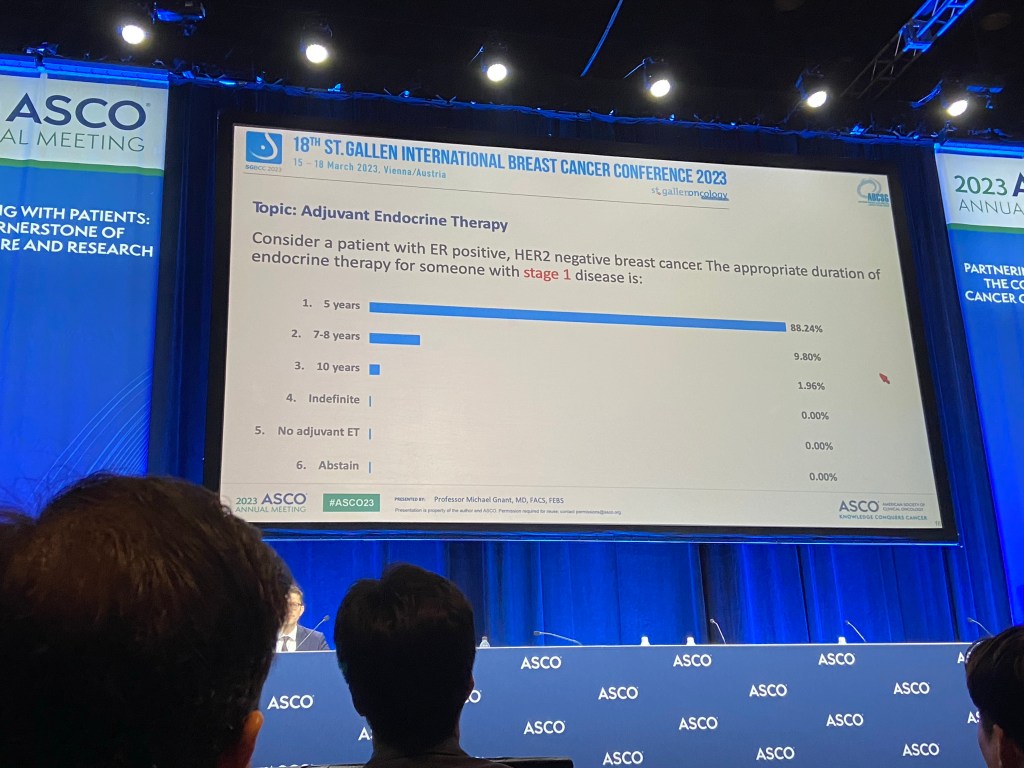
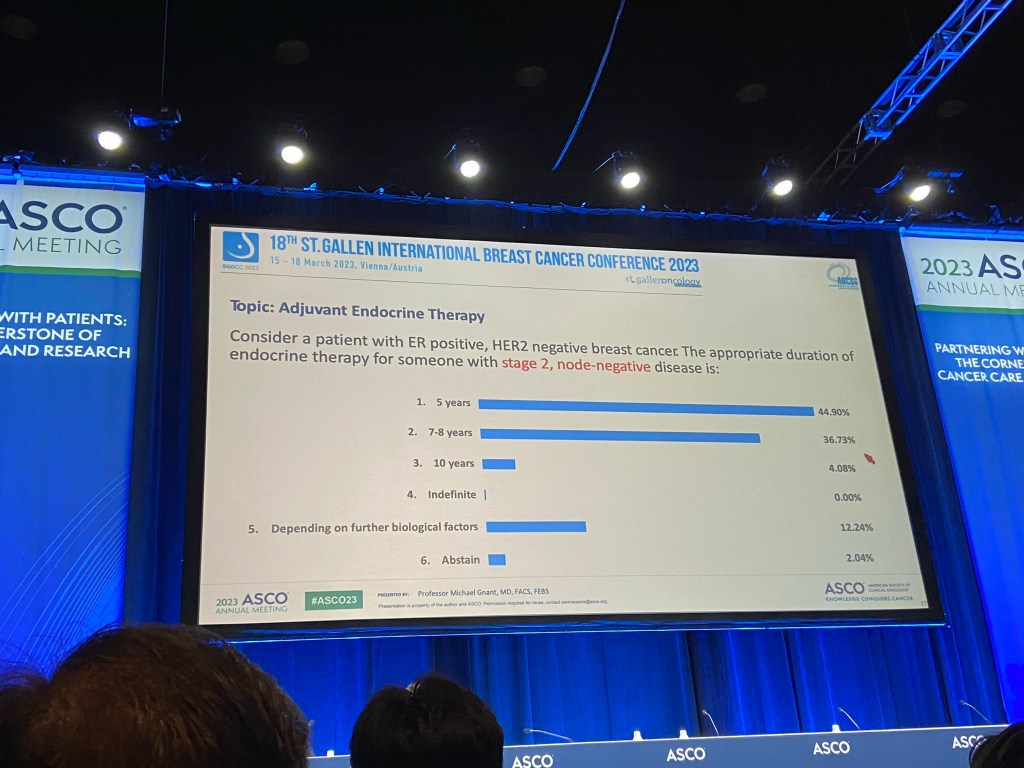
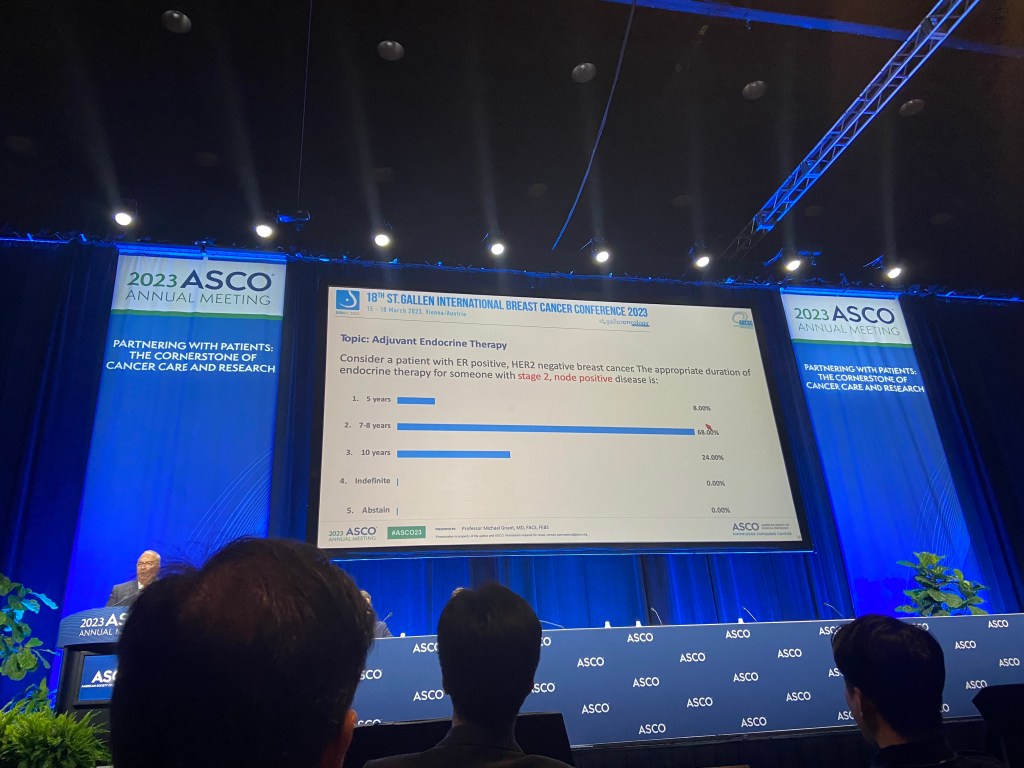
It is a well known fact the taking anti-female (anti-oestrogen) hormone therapy can prevent the cancer from coming back.
But these hormonal therapies do have side effects and there is an ongoing debate about how long patients should take these treatments.
A breast cancer specialists consensus meeting took place recently in Europe. There is emerging consensus that 7-8 years is sufficient on average for lot of low to medium risk patients. The high risk patients do need it for 10 years. ( slides courtesy of ASCO 2023 meeting presentation)
It is important that breast cancer patients talk to their oncologist about these data before they take any action !
Disclaimer: Please note – This blog is NOT medical advice. This blog is NOT a expert medical opinion on various topics. This blog is purely for information only and do check the sources where cited. Please DO consult your own doctor to discuss concerns and options relevant to you. The views expressed in this blog are NOT, in any way whatsoever, intended to be a substitute for professional advice. The blog is NOT previewed, commissioned or otherwise endorsed, in any way, by any organisation that the author is associated with. The views expressed in this blog likely represents some of the author’s personal views held at the time of drafting the blog and MAY CHANGE overtime, particularly when new evidence comes to light.
Low grade ovarian is a difficult cancer to treat with chemotherapy.
So it is quite reassuring to note that a new drug combination is very promising in this setting .
Interim Results were revealed at the American Society of Clinical oncology conference in Chicago.
The study is continuing and the drugs are not available outside the study setting.
Hopefully, in the near future, the final study results of study would lead to this combination becoming standard of care in routine practice. Nothing guaranteed though !
Disclaimer: Please note – This blog is NOT medical advice. This blog is NOT a expert medical opinion on various topics. This blog is purely for information only and do check the sources where cited. Please DO consult your own doctor to discuss concerns and options relevant to you. The views expressed in this blog are NOT, in any way whatsoever, intended to be a substitute for professional advice. The blog is NOT previewed, commissioned or otherwise endorsed, in any way, by any organisation that the author is associated with. The views expressed in this blog likely represents some of the author’s personal views held at the time of drafting the blog and MAY CHANGE overtime, particularly when new evidence comes to light.
Flavanols are natural chemicals present in tea, cocoa, apples, and berries.
A group from Columbia university and Brigham and Women’s Hospital assessed the effects of flavanols and multivitamins on memory.
The authors indicate the in people with poor intake of flavanol, benefitted from flavanol supplements.
Flavanols are naturally found in in certain fruits and vegetables. ( green leafy vegetables, blackcurrants, onions, apples, berries, cherries, peaches, soybeans, citrus foods, tea, chocolate, lettuce, peppers, grapes and even wine).
Even though more confirmatory studies are needed, a good intake of these fruits and vegetables would be beneficial to overall physical health.
5. ORIGINAL paper. (COcoa Supplements and Multivitamin Outcomes Study – COSMOS-Web): “Dietary flavanols restore hippocampal-dependent memory in older adults with lower diet quality and habitual flavanol consumption” according to authors published in Proceedings of the National Academy of Sciences. ( doi : not live at time of publication of blog).
Disclaimer: Please note – This blog is NOT medical advice. This blog is NOT a expert medical opinion on various topics. This blog is purely for information only and do check the sources where cited. Please DO consult your own doctor to discuss concerns and options relevant to you. The views expressed in this blog are NOT, in any way whatsoever, intended to be a substitute for professional advice. The blog is NOT previewed, commissioned or otherwise endorsed, in any way, by any organisation that the author is associated with. The views expressed in this blog likely represents some of the author’s personal views held at the time of drafting the blog and MAY CHANGE overtime, particularly when new evidence comes to light.
Disclaimer: Please note – This blog is NOT medical advice. This blog is NOT a expert medical opinion on various topics. This blog is purely for information only and do check the sources where cited. Please DO consult your own doctor to discuss concerns and options relevant to you. The views expressed in this blog are NOT, in any way whatsoever, intended to be a substitute for professional advice. The blog is NOT previewed, commissioned or otherwise endorsed, in any way, by any organisation that the author is associated with. The views expressed in this blog likely represents some of the author’s personal views held at the time of drafting the blog and MAY CHANGE overtime, particularly when new evidence comes to light.
Yes, many studies do suggest that skipping breakfast is bad for health.
Skipping breakfast increases risk of obesity, high blood pressure, diabetes and heart diseases.
A recent Guardian article provides a different view point and suggests that it may not be harmful to skip breakfast if you do not overindulge during lunch or later in the day with unhealthy food. There is some evidence to suggest that people who skip breakfast as part of planned dieting may benefit from it. The evidence is still evolving though.
People often skip breakfast because they are rushing from home to work; These people who are under lot of stress and juggling too many things in life, tend to eat unhealthily later in the day.
Many people do not have enough energy to continue fasting until Lunch. So skipping breakfast is not a good option for many.
The best thing would be to eat a healthy but light breakfast that keeps one going at work until lunch break.
Disclaimer: Please note – This blog is NOT medical advice. This blog is NOT a expert medical opinion on various topics. This blog is purely for information only and do check the sources where cited. Please DO consult your own doctor to discuss concerns and options relevant to you. The views expressed in this blog are NOT, in any way whatsoever, intended to be a substitute for professional advice. The blog is NOT previewed, commissioned or otherwise endorsed, in any way, by any organisation that the author is associated with. The views expressed in this blog likely represents some of the author’s personal views held at the time of drafting the blog and MAY CHANGE overtime, particularly when new evidence comes to light.
NHS – National Health Service in UK – is a free universal health care system and has been publicly funded since its introduction in 1948. Since it is free at point of delivery, all sections of population are able to access it regardless of their ability to pay.
Unfortunately, due to underfunding and increasing demand, NHS is struggling to cope and there are long waiting times for most services.
Similarly, there is a potential for charges for appointments to reduce demand in NHS. The charges might stop patients making GP appointments for simple pain killers, Skin creams, anti-allergy tablets and indigestion medicines as these medicines are available to buy over the counter from pharmacies and supermarkets.
Charges might also reduce unnecessary attendances at Emergency departments.
Would they really work in practice?
No one knows for sure; a trial in an area of country might be the only way to find out whether it works in UK.
Disclaimer: Please note – This blog is NOT medical advice. This blog is NOT a expert medical opinion on various topics. This blog is purely for information only and do check the sources where cited. Please DO consult your own doctor to discuss concerns and options relevant to you. The views expressed in this blog are NOT, in any way whatsoever, intended to be a substitute for professional advice. The blog is NOT previewed, commissioned or otherwise endorsed, in any way, by any organisation that the author is associated with. The views expressed in this blog likely represents some of the author’s personal views held at the time of drafting the blog and MAY CHANGE overtime, particularly when new evidence comes to light
A large study looked at people born across England, Scotland and Wales in 1970 and followed-up throughout childhood and adulthood
A report of the study with 4481participants (52% female) found that moderate and vigorous physical activity helps cognition compared to light intensity physical activity.
But a word of caution though !
People with sedentary behaviour in this study had better brain sharpness than doing light intensity physical activity !
It seems bizarre to suggest Sedentary activities are good for brain !
We don’t know why this study showed this particularly unexpected finding. It could be that the study missed to collect some important information that influences brain.
This fact about sedentary behaviour is counterintuitive but science does sometimes show unexpected results. Sometimes unexpected findings are true and Sometimes they are false due to data collection issues or convoluted statistical tests.
That’s why it is important that information from multiple studies is taken together rather than relying on one study to make any scientific conclusion on any topic !
Minerva. BMJ. Physical activity and cognition in middle age.
Disclaimer: Please note – This blog is NOT medical advice. This blog is NOT a expert medical opinion on various topics. This blog is purely for information only and do check the sources where cited. Please DO consult your own doctor to discuss concerns and options relevant to you. The views expressed in this blog are NOT, in any way whatsoever, intended to be a substitute for professional advice. The blog is NOT previewed, commissioned or otherwise endorsed, in any way, by any organisation that the author is associated with. The views expressed in this blog likely represents some of the author’s personal views held at the time of drafting the blog and MAY CHANGE overtime, particularly when new evidence comes to light.
Many people try to have a healthy diet without compromising taste.
Hence lot of low calorie foods have artificial sweeteners.
But artificial sweeteners are not a risk free option.
A French study looked at safety of various artificial sweeteners as (aspartame, acesulfame potassium, and sucralose) in a variety of foods and drinks (beverages, table top sweeteners, dairy products, etc).
They found that artificial sweeteners increased the risk of heart problems and risk of strokes.
References
Artificial sweeteners and risk of cardiovascular diseases: results from the prospective NutriNet-Santé cohort BMJ 2022; 378 doi: https://doi.org/10.1136/bmj-2022-071204 (Published 07 September 2022) Cite this as: BMJ 2022;378:e071204
Disclaimer: Please note – This blog is NOT medical advice. This blog is NOT a expert medical opinion on various topics. This blog is purely for information only and do check the sources where cited. Please DO consult your own doctor to discuss concerns and options relevant to you. The views expressed in this blog are NOT, in any way whatsoever, intended to be a substitute for professional advice. The blog is NOT previewed, commissioned or otherwise endorsed, in any way, by any organisation that the author is associated with. The views expressed in this blog likely represents some of the author’s personal views held at the time of drafting the blog and MAY CHANGE overtime, particularly when new evidence comes to light.
Calcium is very essential not only for bone health but also for good functioning of many organs.
Too little calcium is bad but too much of calcium is also harmful.
Because calcium supplements are freely sold in Supermarkets and Pharmacies, many people assume they are absolutely safe.
A study published in Heart journal suggests that calcium supplements has the potential to damage heart valves.
The study also found that “Oral calcium supplementation with or without vitamin D is associated with lower survival”.
The results obviously need to be confirmed by other studies.
In the meantime, anyone with good amount of calcium in their routine diet need to think carefully about risk versus benefits of calcium supplements before taking them.
Disclaimer: Please note – This blog is NOT medical advice. This blog is NOT a expert medical opinion on various topics. This blog is purely for information only and do check the sources where cited. Please DO consult your own doctor to discuss concerns and options relevant to you. The views expressed in this blog are NOT, in any way whatsoever, intended to be a substitute for professional advice. The blog is NOT previewed, commissioned or otherwise endorsed, in any way, by any organisation that the author is associated with. The views expressed in this blog likely represents some of the author’s personal views held at the time of drafting the blog and MAY CHANGE overtime, particularly when new evidence comes to light.
A recent study conducted in U.K. later looked at the problem of smoking in pregnant women.
The study gave money to pregnant women if women stopped smoking.
The study found that giving money up to 400 pounds made some women stop smoking but sadly, the women stopped smoking only for a short period. After six months, there was NO significant difference between women given money and women given only usual advice about smoking.
The first issue with this study is the principle of “inducing / bribing” people with money to give up unhealthy habits. Shouldn’t the healthcare staff educate women rather than giving money for bad behaviour?
The second issue is no one knows whether the money was used wisely. Pregnant women who smoke are likely to have other vices such as unhealthy diet, physical inactivity, alcohol misuse, use of recreational drugs etc. Unhealthy behaviours cluster.
Giving money may have encouraged the women to stop smoking temporarily but the money could have used by women to replace smoking with other unhealthy behaviours. Unfortunately, the study doesn’t seem to looked at this problem.
In the study, two thirds of adverse events occurred in women given money vouchers. The authors have naively dismissed them as unrelated. The increase in adverse events suggests that women, who were given money, may have used the money unwisely. Perversely this well intentioned attempt to encourage good behaviour seem to have caused harm !
Finally, most women who smoke during pregnancy are likely to be from lower socioeconomic group. Poverty is the underlying reason for most of their problems in life including unhealthy habits.
The Healthcare staff in UK are dealing with multiple crisis at present. It is beyond the ability of NHS staff to deal with poverty. The government through social services and public-health team should deal with poverty.
Effect of financial voucher incentives provided with UK stop smoking services on the cessation of smoking in pregnant women (CPIT III): pragmatic, multicentre, single blinded, phase 3, randomised controlled trial. BMJ 2022; 379 doi: https://doi.org/10.1136/bmj-2022-071522 (Published 19 October 2022)
Disclaimer: Please note – This blog is NOT medical advice. This blog is NOT a expert medical opinion on various topics. This blog is purely for information only and do check the sources where cited. Please DO consult your own doctor to discuss concerns and options relevant to you. The views expressed in this blog are NOT, in any way whatsoever, intended to be a substitute for professional advice. The blog is NOT previewed, commissioned or otherwise endorsed, in any way, by any organisation that the author is associated with. The views expressed in this blog likely represents some of the author’s personal views held at the time of drafting the blog and MAY CHANGE overtime, particularly when new evidence comes to light.
At least according to an Australian study published earlier this year.
Previously some studies suggested a benefit for Vitamin D supplements in older people.
In 2014, a Cochrane review suggested that vitamin D, supplements might reduce risk of death in older people. The esteemed Cochrane review recommended further studies.
A randomised controlled trial of oral vitamin D, supplementation for five years in Australians aged 60 or older reports no benefits. Among 20 000 participants followed for five years, the primary outcome–death from any cause. occurred as frequently in those taking the active supplement as it did in those taking placebo.
Disclaimer: Please note – This blog is NOT medical advice. This blog is NOT a expert medical opinion on various topics. This blog is purely for information only and do check the sources where cited. Please DO consult your own doctor to discuss concerns and options relevant to you. The views expressed in this blog are NOT, in any way whatsoever, intended to be a substitute for professional advice. The blog is NOT previewed, commissioned or otherwise endorsed, in any way, by any organisation that the author is associated with. The views expressed in this blog likely represents some of the author’s personal views held at the time of drafting the blog and MAY CHANGE overtime, particularly when new evidence comes to light.
Patients trust their doctors to do their job competently with due diligence each and every time, without any exception.
In an ideal world, doctors should do their utmost to justify their patients trust and confidence.
Doctors who persistently underperform need to be punished. Doctors who willfully and knowingly harm their patients should be punished harshly.
But doctors are human beings. Human beings are never perfect in whatever work they do.
Furthermore, the “Practice of Medicine” is more of an art balancing probabilities rather than an exact science with discrete answers all the time to every problem.
So unintentional medical errors happen all the time.
There are extremely few doctors who haven’t done an honest mistake or error in their entire career. So if all doctors are punished harshly each and every-time an honest error occurs , there will be few doctors left who won’t practice defensively.
Defensive medicine has a cost. Defensive Medicine would push up the cost of medical care further. And fewer and fewer people would be able to afford medical care.
Read my personal views on BMJ website and submit your views on the BMJ rapid response section
Disclaimer: Please note – This blog is NOT medical advice. This blog is NOT a expert medical opinion on various topics. This blog is purely for information only and do check the sources where cited. Please DO consult your own doctor to discuss concerns and options relevant to you. The views expressed in this blog are NOT, in any way whatsoever, intended to be a substitute for professional advice. The blog is NOT previewed, commissioned or otherwise endorsed, in any way, by any organisation that the author is associated with. The views expressed in this blog likely represents some of the author’s personal views held at the time of drafting the blog and MAY CHANGE overtime, particularly when new evidence comes to light.
GP suspension for failure to refer fast track. GMC: harsh punishment is a sword of Damocles. BMJ 2022; 378 doi: https://doi.org/10.1136/bmj.o1828 (Published 26 July 2022)Cite this as: BMJ 2022;378:o1828
Many people would be surprised to learn that cancer patients with advanced incurable cancer actively choose chemotherapy for relatively small benefits.
Chemotherapy has the potential to relieve cancer related symptoms but in many advanced cancers, Chemotherapy prolongs survival ( on average ) only by a few months . Yet, lot of patients do opt to try chemotherapy which can be sometimes quite toxic.
Even in countries such as U.K. where oncologists are NOT on a fee for service contract (such as NHS), lot of patients do opt for Chemotherapy.
Perhaps, Chemotherapy gives hope for people not ready to face death.
Read my views in BMJ and contribute your thoughts on this topic through the rapid response section of online BMJ.
Disclaimer: Please note – This blog is NOT medical advice. This blog is NOT a expert medical opinion on various topics. This blog is purely for information only and do check the sources where cited. Please DO consult your own doctor to discuss concerns and options relevant to you. The views expressed in this blog are NOT, in any way whatsoever, intended to be a substitute for professional advice. The blog is NOT previewed, commissioned or otherwise endorsed, in any way, by any organisation that the author is associated with. The views expressed in this blog likely represents some of the author’s personal views held at the time of drafting the blog and MAY CHANGE overtime, particularly when new evidence comes to light.
Although it is obvious exercise helps, it is good to have definitive evidence from good studies.
A large Australian study involving 5000 elderly women (average age 79) looked at the physical activity of these women for over a week.
After that, the women were followed up for the next seven years, and 400 of them developed diabetes. Not surprisingly, women with higher step count were found to be at lower risk of developing diabetes. Each extra 2000 steps per day was found to reduce the diabetes risk by 12% fall.
Another study from Sweden also showed that high daily step count reduces the risk of diabetes in elderly people.
Disclaimer: Please note – This blog is NOT medical advice. This blog is NOT a expert medical opinion on various topics. This blog is purely for information only and do check the sources where cited. Please DO consult your own doctor to discuss concerns and options relevant to you. The views expressed in this blog are NOT, in any way whatsoever, intended to be a substitute for professional advice. The blog is NOT previewed, commissioned or otherwise endorsed, in any way, by any organisation that the author is associated with. The views expressed in this blog likely represents some of the author’s personal views held at the time of drafting the blog and MAY CHANGE overtime, particularly when new evidence comes to light
Hopefully, Virtual colonoscopy will play an important complementary role in early diagnosis of bowel ( colon) cancer.
Disclaimer: Please note – This blog is NOT medical advice. This blog is NOT a expert medical opinion on various topics. This blog is purely for information only and do check the sources where cited. Please DO consult your own doctor to discuss concerns and options relevant to you. The views expressed in this blog are NOT, in any way whatsoever, intended to be a substitute for professional advice. The blog is NOT previewed, commissioned or otherwise endorsed, in any way, by any organisation that the author is associated with. The views expressed in this blog likely represents some of the author’s personal views held at the time of drafting the blog and MAY CHANGE overtime, particularly when new evidence comes to light.
Water Intake, Water Balance, and the Elusive Daily Water Requirement. Lawrence E. Armstrong and Evan C. Johnson. Nutrients. 2018 Dec; 10(12): 1928. Published online 2018 Dec 5. doi: 10.3390/nu10121928 PMCID: PMC6315424 (daily total water intake (TWI, L/24h) ˂1.8 L” may influence the risk of dysfunctional metabolism and chronic diseases.
Daily Telegraph. Why sipping water could help you lose weight. Robert Pattinson did it for his role as Batman and bodybuilders do it before an event, but doctors advise a measured approach By Sharon Walker 6 March 2022 • 12:00pm
A word of caution applies to all ‘food/ drink and disease’ association reports. Almost every week there are newspaper reports of studies exploring associations between “various food/drink” with “various diseases” and “health”. Some of them are conflicting and confusing with a positive study followed by a negative study ! This news report is no different in that respect.
A study published in British Medical Journal (BMJ) looked at 7195 permanent residents living in 60 residential aged-care facilities in Australia.
Over a two year period, they provided residents in half the facilities (30 facilities) with additional milk, yoghurt, and cheese. The residents in the remaining 30 facilities who served as controls had their usual menus.
The study found that the additional calcium in diet is beneficial.
Improving calcium and protein intakes reduced the risk of falls and fractures that commonly occur in aged care residents.
References: Effect of dietary sources of calcium and protein on hip fractures and falls in older adults in residential care: cluster randomised controlled trial BMJ 2021; 375 doi: https://doi.org/10.1136/bmj.n2364 (Published 21 October 2021) Cite this as: BMJ 2021;375:n2364
Disclaimer: Please note – This blog is NOT medical advice. This blog is NOT a expert medical opinion on various topics. This blog is purely for information only and do check the sources where cited. Please DO consult your own doctor to discuss concerns and options relevant to you. The views expressed in this blog are NOT, in way whatsoever, intended to be a substitute for professional advice. The blog is NOT previewed, commissioned or otherwise endorsed, in any way, by any organisation that the author is associated with. The views expressed in this blog likely represents some of the author’s personal views held at the time of drafting the blog and MAY CHANGE overtime, particularly when new evidence comes to light.
We still don’t know a lot about cancers, how they start, when they start and what keeps them going.
We already know that some of the changes seen more often in cancerous tissues than in normal tissues can help to devise anti-cancer treatments. Examples include Herceptin for Breast cancer, Olaparib for Ovarian cancer.
But there is a lot a do if we were to cure or control cancers.
A recently published study by the Cambridge team is quite exciting. It probably would lead to more similar studies and ultimately better and more effective cancer treatments.
The study analysed all the genetic material from cancers (“whole genome”) and found “genetic finger prints” in various cancers . Targeting these changes could help to diagnose and treat cancers more effectively.
A word of caution: it usually makes many years for the new discoveries to lead to better treatments. Clinical trials often take years to start, recruit and analyse results.
Disclaimer: Please note – This blog is NOT medical advice. This blog is NOT a expert medical opinion on various topics. This blog is purely for information only and do check the sources where cited. Please DO consult your own doctor to discuss concerns and options relevant to you. The views expressed in this blog are NOT, in any way whatsoever, intended to be a substitute for professional advice. The blog is NOT previewed, commissioned or otherwise endorsed, in any way, by any organisation that the author is associated with. The views expressed in this blog likely represents some of the author’s personal views held at the time of drafting the blog and MAY CHANGE overtime, particularly when new evidence comes to light
Once we come out of this COVID pandemic, everyone’s attention needs to be focused on the obesity pandemic.
During the COVID pandemic, lot of people started to focus on their physical fitness. People invested in Home Exercise equipment and in wearable technology such as Fitness monitors.
Even before this pandemic, lot of people have started using Fitness monitors.
Are they any good?
A recent study published in British Medical Journal (BMJ) looked the effectiveness of physical activity monitors.
The study authors looked at more than 120 trials involving more than 16 700 participants.
Most of studies they looked at were either European (31%) or North American (40%). Most of these studies included healthy participants (47%), although some included overweight participants (17%).
They found Fitness monitors are generally safe and help to increase physical activity.
Whether the Fitness monitors will help overweight people to lose weight permanently over long term needs further investigation.
References:
Effectiveness of physical activity monitors in adults: systematic review and meta-analysis. BMJ 2022; 376 doi: https://doi.org/10.1136/bmj-2021-068047 (Published 26 January 2022)Cite this as: BMJ 2022;376:e068047
Gov.UK. Physical activity: applying All Our Health Office for Health Improvement & Disparities Guidance. Physical activity: applying All Our Health. Updated 16 October 2019
Disclaimer: Please note – This blog is NOT medical advice. This blog is NOT a expert medical opinion on various topics. This blog is purely for information only and do check the sources where cited. Please DO consult your own doctor to discuss concerns and options relevant to you. The views expressed in this blog are NOT, in any way whatsoever, intended to be a substitute for professional advice. The blog is NOT previewed, commissioned or otherwise endorsed, in any way, by any organisation that the author is associated with. The views expressed in this blog likely represents some of the author’s personal views held at the time of drafting the blog and MAY CHANGE overtime, particularly when new evidence comes to light.
The drug Baricitinib is not a brand new drug. It is normally used to treat a type of joint problem called rheumatoid arthritis. Now, this drug has been found to be very beneficial in patients suffering from severe COVID.
The drug was evaluated as part of the renowned RECOVERY trial.
RECOVERY ( Randomised Evaluation of Covid-19 Therapy) trial is led by investigators in U.K.
The trial found that Baricitinib reduces the risk of death by around one fifth in patients with severe covid-19.
On the other hand, Some bad news about a drug who was thought to be promising before. Questions have been raised about the actual benefit , if any, from a previously approved drug called Molnupiravir.
Overall, at present, we have lot more drugs to tackle COVID in addition to the Vaccines.
References
BMJ. Covid-19: Anti-inflammatory treatment baricitinib reduces deaths in patients admitted to hospital, finds trial BMJ 2022; 376 doi: https://doi.org/10.1136/bmj.o573 (Published 03 March 2022) Cite this as: BMJ 2022;376:o573
Guardian. Arthritis drug could help save Covid patients – study Rheumatoid arthritis drug baricitinib can reduce risk of death from severe Covid by about a fifth Nicola Davis Science correspondent @NicolaKSDavis Thu 3 Mar 2022 18.07 GMT
BMJ. Molnupiravir’s authorisation was premature BMJ 2022; 376 doi: https://doi.org/10.1136/bmj.o443 (Published 03 March 2022) Cite this as: BMJ 2022;376:o443
Disclaimer: Please note – This blog is NOT medical advice. This blog is NOT a expert medical opinion on various topics. This blog is purely for information only and do check the sources where cited. Please DO consult your own doctor to discuss concerns and options relevant to you. The views expressed in this blog are NOT, in any way whatsoever, intended to be a substitute for professional advice. The blog is NOT previewed, commissioned or otherwise endorsed, in any way, by any organisation that the author is associated with. The views expressed in this blog likely represents some of the author’s personal views held at the time of drafting the blog and MAY CHANGE overtime, particularly when new evidence comes to light.
The team investigated brain changes in 785 UK Biobank participants (aged 51–81).
The team compared Brain scans before COVID infection and Brain scans after infection.
They found that people with COVID subsequently had “brain shrinkage” and reduced “brain function” particularly relating to parts of brain dealing with emotions smell and long-term memory
It is not known whether these brain changes are temporary and reversible after a while or whether these changes are permanent.
Disclaimer: Please note – This blog is NOT medical advice. This blog is NOT a expert medical opinion on various topics. This blog is purely for information only and do check the sources where cited. Please DO consult your own doctor to discuss concerns and options relevant to you. The views expressed in this blog are NOT, in any way whatsoever, intended to be a substitute for professional advice. The blog is NOT previewed, commissioned or otherwise endorsed, in any way, by any organisation that the author is associated with. The views expressed in this blog likely represents some of the author’s personal views held at the time of drafting the blog and MAY CHANGE overtime, partic
Many people report that they have seen many of their friends and family and work colleagues have caught the COVID virus during the recent wave.
Why did so many vaccinated people catch the infection?
It’s because of two reasons. (1) the vaccines are not 100% effective and (2) there is substantial reduction in vaccines effectiveness over time.
A large U.K. study looked at vaccine effectiveness against symptomatic disease caused by the omicron and delta variants in England.
Frighteningly, No effect against the omicron variant was noted from 20 weeks after two Astra Zeneca vaccine doses, and the effectiveness of two Pfizer vaccine was only marginally better with 8.8% protection at 25 or more weeks after two Vaccine doses.
Vaccine effectiveness improved to about 65% protection at 2 to 4 weeks after a third Pfizer booster but this was not long lasting and the effectiveness decreased to about before decreasing to 44% at 10 or more weeks after Vaccination.
In summary, Vaccination with two doses of AstraZeneca or Pfizer vaccine provided limited protection against symptomatic disease caused by the omicron variant.
A third booster with Pfizer or Moderna vaccine substantially increased the protection, but even that protection gradually decreased over time.
This study, published in the Prestigious NEJM journal, was Funded by the U.K. Health Security Agency and hence highly reliable.
One has to hope that any new variants do not bypass the vaccine protection and cause much more severe disease than omicron!
Nature magazine. Iketani, S., Liu, L., Guo, Y. et al. Antibody evasion properties of SARS-CoV-2 Omicron sublineages. Nature (2022). https://doi.org/10.1038/s41586-022-04594-4 ( substantial loss in neutralizing activity against omicron variant)
Disclaimer: Please note – This blog is NOT medical advice. This blog is NOT a expert medical opinion on various topics. This blog is purely for information only and do check the sources where cited. Please DO consult your own doctor to discuss concerns and options relevant to you. The views expressed in this blog are NOT, in any way whatsoever, intended to be a substitute for professional advice. The blog is NOT previewed, commissioned or otherwise endorsed, in any way, by any organisation that the author is associated with. The views expressed in this blog likely represents some of the author’s personal views held at the time of drafting the blog and MAY CHANGE overtime, partic
Yes, the COVID vaccines struggle to boost the immunity against COVID in people who have a defective or suppressed immune system.
A recent study published in BMJ looked at all relevant publications and confirms this. Cancer patients and patients who have received organ transplants are at risk of inadequate protection from the vaccines.
It is important that people who have low immunity get boosters as recommended by the guidelines ( third or fourth dose).
References
BMJ. Efficacy of covid-19 vaccines in immunocompromised patients: systematic review and meta-analysis BMJ 2022; 376 doi: https://doi.org/10.1136/bmj-2021-068632 (Published 02 March 2022) Cite this as: BMJ 2022;376:e068632
Disclaimer: Please note – This blog is NOT medical advice. This blog is NOT a expert medical opinion on various topics. This blog is purely for information only and do check the sources where cited. Please DO consult your own doctor to discuss concerns and options relevant to you. The views expressed in this blog are NOT, in any way whatsoever, intended to be a substitute for professional advice. The blog is NOT previewed, commissioned or otherwise endorsed, in any way, by any organisation that the author is associated with. The views expressed in this blog likely represents some of the author’s personal views held at the time of drafting the blog and MAY CHANGE overtime, particularly when new evidence comes to light.
Diclofenac is sometimes overlooked as a pain killer before people go on to stronger morphine-like prescription pain killers.
A study published in BMJ suggests that Diclofenac tablets take by mouth is effective for pain due to arthritis.
Overall, Diclofenac, taken by mouth, seem to be effective and generally safer than Opiod drugs. But caution is needed particularly in elderly people with multiple other medical problems.
Interestingly, Diclofenac Cream applied over the skin and Joints seem to be particularly effective for Knee arthritis pain.
Applying the cream also overcomes the problem of Diclofenac side effects, since very little of Diclofenac reaches other parts of the body.
The authors recommend Diclofenac Skin Cream as first line pharmacological treatment for knee osteoarthritis.
References
BMJ. Effectiveness and safety of non-steroidal anti-inflammatory drugs and opioid treatment for knee and hip osteoarthritis: network meta-analysis BMJ 2021; 375 doi: https://doi.org/10.1136/bmj.n2321 (Published 12 October 2021) Cite this as: BMJ 2021;375:n2321
Disclaimer: Please note – This blog is NOT medical advice. This blog is NOT a expert medical opinion on various topics. This blog is purely for information only and do check the sources where cited. Please DO consult your own doctor to discuss concerns and options relevant to you. The views expressed in this blog are NOT, in way whatsoever, intended to be a substitute for professional advice. The blog is NOT previewed, commissioned or otherwise endorsed, in any way, by any organisation that the author is associated with. The views expressed in this blog likely represents some of the author’s personal views held at the time of drafting the blog and MAY CHANGE overtime, particularly when new evidence comes to light.
They assessed the “smartness” by using an online test. The study involved 600 aerospace engineers ( rocket scientists) and 148 neurosurgeons ( brain surgeons).
This online test known as “Cognitron’s Great British Intelligence Test” measured distinct aspects of cognition, spanning planning and reasoning, working memory, attention, and emotion processing abilities.
The brain surgeons had higher scores than the rocket scientists in semantic problem solving. The rocket scientists got higher scores in mental manipulation and attention.
With many other sections of the tests, the brain surgeons and rocket scientists did not do a lot better than the general population !
The study concludes that both neurosurgeons and aerospace engineers are unnecessarily placed on a pedestal with common phrases such as “It’s not rocket science” and “It’s not brain surgery”.
This study does NOT prove the experts do not know much more than general public.
The study does NOT mean that “social media rants” and “conspiracy theories” are somehow right !
Would you let a lay person operate on your brain ?
Technical and Scientific Expertise is still valuable !
References
“It’s not rocket science” and “It’s not brain surgery”—“It’s a walk in the park”: prospective comparative study BMJ 2021; 375 doi: https://doi.org/10.1136/bmj-2021-067883 (Published 13 December 2021) Cite this as: BMJ 2021;375:e067883
Disclaimer: Please note – This blog is NOT medical advice. This blog is NOT a expert medical opinion on various topics. This blog is purely for information only and do check the sources where cited. Please DO consult your own doctor to discuss concerns and options relevant to you. The views expressed in this blog are NOT, in any way whatsoever, intended to be a substitute for professional advice. The blog is NOT previewed, commissioned or otherwise endorsed, in any way, by any organisation that the author is associated with. The views expressed in this blog likely represents some of the author’s personal views held at the time of drafting the blog and MAY CHANGE overtime, particularly when new evidence comes to light.
A UK Biobank study analysed more than 325,000 individuals of European ancestry. The study found that people with low mood are at higher risk of developing heart and blood sugar problems. [ medical terms- coronary artery disease (CAD), type 2 diabetes (T2D) and atrial fibrillation].
Individuals with depression in this study were more likely to be current smokers; reported less vegetable and fresh fruit intake, less exercise and sleep; and had higher body weight (body mass index – BMI).
Even though the study adjusted the statistics for various baseline factors, one cannot help wonder whether there are yet unidentified factors at play.
Disclaimer: Please note – This blog is NOT medical advice. This blog is NOT a expert medical opinion on various topics. This blog is purely for information only and do check the sources where cited. Please DO consult your own doctor to discuss concerns and options relevant to you. The views expressed in this blog are NOT, in any way whatsoever, intended to be a substitute for professional advice. The blog is NOT previewed, commissioned or otherwise endorsed, in any way, by any organisation that the author is associated with. The views expressed in this blog likely represents some of the author’s personal views held at the time of drafting the blog and MAY CHANGE overtime, particularly when new evidence comes to light.
Penninkilampi R, Eslick GD. Perineal talc use and ovarian cancer: a systematic review and meta-analysis. Epidemiology. 2018;29(1):41-49. doi:10.1097/EDE.0000000000000745
Disclaimer: Please note- This blog is NOT medical advice. This blog is purely for information only and do check the the sources where cited. Please DO consult your own doctor to discuss concerns and options relevant to you.
The views expressed in this blog represent the author’s views held at the time of drafting the blog and may change overtime, particularly when new evidence comes to light. The blog is not necessarily endorsed by any organisation the author is associated with and views are not substitute for professional advice.
In this study involving more than 33 million people, the long term protection of Pfizer-BioNTech and Moderna vaccines was assessed.
Vaccine effectiveness against any SARS-CoV-2 infection significantly decreased from 82% to 33% at about 7 months after the second dose.
Vaccine effectiveness against severe covid-19 (admission to hospital or death) was much better though. The effectiveness decreased but to a much lesser extent, from 96% to 80%.
This Italian study confirms that a booster dose of vaccine six months after the primary vaccination cycle is the best way forward.
Reference: Effectiveness of mRNA vaccines and waning of protection against SARS-CoV-2 infection and severe covid-19 during predominant circulation of the delta variant in Italy: retrospective cohort study BMJ 2022; 376 doi: https://doi.org/10.1136/bmj-2021-069052 (Published 10 February 2022) Cite this as: BMJ 2022;376:e069052
Disclaimer: Please note – This blog is NOT medical advice. This blog is NOT a expert medical opinion on various topics. This blog is purely for information only and do check the sources where cited. Please DO consult your own doctor to discuss concerns and options relevant to you. The views expressed in this blog are NOT, in any way whatsoever, intended to be a substitute for professional advice. The blog is NOT previewed, commissioned or otherwise endorsed, in any way, by any organisation that the author is associated with. The views expressed in this blog likely represents some of the author’s personal views held at the time of drafting the blog and MAY CHANGE overtime, particularly when new evidence comes to light
Most people assume that nutritional supplements are always beneficial. But it is not always the case.
Paradoxically, the people, who may need the supplements because they don’t have a healthy diet, are the often ones who do not take the supplements !
But people, who usually do not need various supplements, because they are health conscious and have a good healthy diet, are often the ones who take the supplements unnecessarily !
Sometimes Supplements can be harmful. Hence, the need for clinical trials to assess the benefits and risks of various supplements.
So it is interesting to read a trial in the British Medical Journal (BMJ) which looked at Vitamin D and marine derived omega 3 fatty acids supplements. The study looked the effect of these two supplements in preventing Autoimmune diseases.
Autoimmune disease is a type of disease where body’s own immune system misfires and causes inflammation in self-tissues.
Autoimmune diseases, are often chronic conditions and cause considerable misery.
The study published in BMJ looked at Autoimmune diseases, such as rheumatoid arthritis, polymyalgia rheumatica, autoimmune thyroid disease, psoriasis, and inflammatory bowel disease, and all other new onset autoimmune diseases.
This well conducted study used a dummy pill and hence the results are usually expected to be quite reliable.
About 25 800 participants were enrolled in the study and were followed up for an average of about 5 years.
This large study from United States found that vitamin D and omega 3 fatty acid supplementation taken for five years reduces the risk of developing autoimmune diseases.
Disclaimer: Please note – This blog is NOT medical advice. This blog is NOT a expert medical opinion on various topics. This blog is purely for information only and do check the sources where cited. Please DO consult your own doctor to discuss concerns and options relevant to you. The views expressed in this blog are NOT, in any way whatsoever, intended to be a substitute for professional advice. The blog is NOT previewed, commissioned or otherwise endorsed, in any way, by any organisation that the author is associated with. The views expressed in this blog likely represents some of the author’s personal views held at the time of drafting the blog and MAY CHANGE overtime, particularly when new evidence comes to light.
Practically all interventions or even non-interventions can cause harm. For example, a doctor simply encouraging a patient to drink more water or recommending bed rest can be harmful in certain medical circumstances.
Many medical harms ( side effects and complications) are certainly not due to significant clinical negligence.
But in the small minority where harm is due to clinical negligence ( albeit un-intentional ), getting compensation is not straightforward.
It is a shame that not everyone who suffers medical harm is able to seek compensation.
Patients usually have to prove medical negligence to get compensation and only a small fraction of people do have the time, money and drive to pursue a negligence claim through legal process. It seems like a jack-pot where a few win big amounts while others receive nothing.
Folic acid supplementation and the complexities of blame. BMJ 2022; 376 doi: https://doi.org/10.1136/bmj.o144 (Published 20 January 2022)Cite this as: BMJ 2022;376:o144
Disclaimer: Please note – This blog is NOT medical advice. This blog is NOT a expert medical opinion on various topics. This blog is purely for information only and do check the sources where cited. Please DO consult your own doctor to discuss concerns and options relevant to you. The views expressed in this blog are NOT, in any way whatsoever, intended to be a substitute for professional advice. The blog is NOT previewed, commissioned or otherwise endorsed, in any way, by any organisation that the author is associated with. The views expressed in this blog likely represents some of the author’s personal views held at the time of drafting the blog and MAY CHANGE overtime, particularly when new evidence comes to light.
BMJ. Associations between statins and adverse events in primary prevention of cardiovascular disease: systematic review with pairwise, network, and dose-response meta-analyses BMJ 2021; 374 doi: https://doi.org/10.1136/bmj.n1537 (Published 15 July 2021) Cite this as: BMJ 2021;374:n1537
Disclaimer: Please note- This blog is NOT medical advice. This blog is NOT a expert medical opinion on various topics. This blog is purely for information only and do check the sources where cited. Please DO consult your own doctor to discuss concerns and options relevant to you. The views expressed in this blog represent the author’s personal views held at the time of drafting the blog and may change overtime, particularly when new evidence comes to light. The blog is NOT previewed, commissioned or otherwise endorsed by any organisation that the author is associated with. The views expressed in this blog are NOT, in way whatsoever, intended to be a substitute for professional advice.
Disclaimer: Please note – This blog is NOT medical advice. This blog is NOT a expert medical opinion on various topics. This blog is purely for information only and do check the sources where cited. Please DO consult your own doctor to discuss concerns and options relevant to you. The views expressed in this blog are NOT, in way whatsoever, intended to be a substitute for professional advice. The blog is NOT previewed, commissioned or otherwise endorsed, in any way, by any organisation that the author is associated with. The views expressed in this blog likely represents some of the author’s personal views held at the time of drafting the blog and MAY CHANGE overtime, particularly when new evidence comes to light.
Disclaimer: Please note – This blog is NOT medical advice. This blog is NOT a expert medical opinion on various topics. This blog is purely for information only and do check the sources where cited. Please DO consult your own doctor to discuss concerns and options relevant to you. The views expressed in this blog are NOT, in way whatsoever, intended to be a substitute for professional advice. The blog is NOT previewed, commissioned or otherwise endorsed, in any way, by any organisation that the author is associated with. The views expressed in this blog likely represents some of the author’s personal views held at the time of drafting the blog and MAY CHANGE overtime, particularly when new evidence comes to light.
Vitamins are absolutely essential nutrients and vitamin deficiency causes various illness.
But a high dose of vitamin, far too much than needed by the body, is also bad.
Everything in moderation is good. Even an abundance of a good thing is bad.
It is similar to food. Lack of food would cause starvation and even death in the extreme. But too much of food causes obesity and other health problems. Same principle applies to vitamins.
A Cochrane review looked at the ability of vitamins to prevent lung cancer. The review concluded that there is “no beneficial effect of supplements for the prevention of lung cancer and lung cancer mortality in healthy people”
Worryingly, the review also found that the following:
– Vitamin A supplements increase lung cancer incidence and mortality in smokers or persons exposed to asbestos”.
– Vitamin C increases lung cancer incidence in women.
– Vitamin E increases the risk of haemorrhagic strokes.
So if you are having a healthy balanced diet, be careful with vitamin supplements.
Disclaimer: Please note- This blog is NOT medical advice. This blog is NOT a expert medical opinion on various topics. This blog is purely for information only and do check the sources where cited. Please DO consult your own doctor to discuss concerns and options relevant to you. The views expressed in this blog represent the author’s views held at the time of drafting the blog and may change overtime, particularly when new evidence comes to light. The blog is not previewed, commissioned or otherwise endorsed by any organisation that the author is associated with. The views expressed in this blog are not, in way whatsoever, intended to be a substitute for professional advice.
Disclaimer: Please note – This blog is NOT medical advice. This blog is NOT a expert medical opinion on various topics. This blog is purely for information only and do check the sources where cited. Please DO consult your own doctor to discuss concerns and options relevant to you. The views expressed in this blog are NOT, in way whatsoever, intended to be a substitute for professional advice. The blog is NOT previewed, commissioned or otherwise endorsed, in any way, by any organisation that the author is associated with. The views expressed in this blog likely represents some of the author’s personal views held at the time of drafting the blog and MAY CHANGE overtime, particularly when new evidence comes to light
The variant seems to have “changed its coat”. The scientists worry that these changes ( mutations) can make it more transmissible and potentially evade vaccines.
U.K government has put six African countries on the Red List. All flights from South Africa, Namibia, Zimbabwe, Botswana, Lesotho and Eswatini are being suspended now.
Disclaimer: Please note – This blog is NOT medical advice. This blog is NOT a expert medical opinion on various topics. This blog is purely for information only and do check the sources where cited. Please DO consult your own doctor to discuss concerns and options relevant to you. The views expressed in this blog are NOT, in way whatsoever, intended to be a substitute for professional advice. The blog is NOT previewed, commissioned or otherwise endorsed, in any way, by any organisation that the author is associated with. The views expressed in this blog likely represents some of the author’s personal views held at the time of drafting the blog and MAY CHANGE overtime, particularly when new evidence comes to light.
Andrew Gregory Health editor Fri 19 Nov 2021 12.29 GMT
A word of caution applies to all ‘food and disease’ association reports. Almost every week there are newspaper reports of studies exploring associations between “various food/drink” with “various diseases”. Some of them are conflicting and confusing with a positive study followed by a negative study !
So don’t be surprised if there is a completely different news report next week !
Disclaimer: Please note – This blog is NOT medical advice. This blog is NOT a expert medical opinion on various topics. This blog is purely for information only and do check the sources where cited. Please DO consult your own doctor to discuss concerns and options relevant to you. The views expressed in this blog are NOT, in way whatsoever, intended to be a substitute for professional advice. The blog is NOT previewed, commissioned or otherwise endorsed, in any way, by any organisation that the author is associated with. The views expressed in this blog likely represents some of the author’s personal views held at the time of drafting the blog and MAY CHANGE overtime, particularly when new evidence comes to light.
IBS or Irritable bowel syndrome is a common condition. Lot of people with IBS also have Anxiety problems.
So it was not known whether anxiety by itself causes the IBS.
A recent study suggests Anxiety and IBS coexist due to genetic abnormalities. Anxiety by itself does not seem to lead to someone developing IBS.
This large U.K. study involving 53,400 cases and 433,201 controls suggests that genes that alter brain–gut interactions may be responsible for IBS.
On the other hand, the overall likelihood of an individual developing IBS due to genes passed down the family seems low.
So with IBS, lot of things about it continue to remain a mystery. How IBS starts and how it progresses is still mostly unknown. Hopefully, future research will clarify things.
Disclaimer: Please note – This blog is NOT medical advice. This blog is NOT a expert medical opinion on various topics. This blog is purely for information only and do check the sources where cited. Please DO consult your own doctor to discuss concerns and options relevant to you. The views expressed in this blog are NOT, in way whatsoever, intended to be a substitute for professional advice. The blog is NOT previewed, commissioned or otherwise endorsed, in any way, by any organisation that the author is associated with. The views expressed in this blog likely represents some of the author’s personal views held at the time of drafting the blog and MAY CHANGE overtime, particularly when new evidence comes to light.
Breastfeeding is best for mother and baby. But for various reasons, it is not possible to breast feed. So Infant formulas (breast milk substitutes) are widely used.
These infant formulas are often modified in the hope of making them equivalent to breast milk.
The study worryingly suggests potential harm from infant formulas supplemented with long chain polyunsaturated fatty acids (LCPUFAs).
Mimicking nature doesn’t always work !
Reference
BMJ. Effect of nutritionally modified infant formula on academic performance: linkage of seven dormant randomised controlled trials to national education data BMJ 2021; 375 doi: https://doi.org/10.1136/bmj-2021-065805 (Published 11 November 2021) Cite this as: BMJ 2021;375:e065805
BMJ. Enriched formula milks and academic performance in later childhood BMJ 2021; 375 doi: https://doi.org/10.1136/bmj.n2661 (Published 11 November 2021) Cite this as: BMJ 2021;375:n2661
Disclaimer: Please note – This blog is NOT medical advice. This blog is NOT a expert medical opinion on various topics. This blog is purely for information only and do check the sources where cited. Please DO consult your own doctor to discuss concerns and options relevant to you. The views expressed in this blog are NOT, in way whatsoever, intended to be a substitute for professional advice. The blog is NOT previewed, commissioned or otherwise endorsed, in any way, by any organisation that the author is associated with. The views expressed in this blog likely represents some of the author’s personal views held at the time of drafting the blog and MAY CHANGE overtime, particularly when new evidence comes to light.
Two new drugs, one from Pfizer and another from Merck promise to provide a new way to fight the virus in vulnerable people.
The oral pills from Pfizer is called Paxlovid. Paxlovid is a combination of two drugs. One drug is a new antiviral drug developed by Pfizer and is called PF-07321332. Another drug is called ritonavir, and ritonavir is already being used to treat HIV/Aids.
The Merck drug is known by the brand name Lagevrio [chemical name is molnupiravir]. This drug is approved by U.K. regulators and is ready to be used in the NHS. The Pfizer drug is yet to be evaluated by authorities for approval.
Disclaimer: Please note – This blog is NOT medical advice. This blog is NOT a expert medical opinion on various topics. This blog is purely for information only and do check the sources where cited. Please DO consult your own doctor to discuss concerns and options relevant to you. The views expressed in this blog are NOT, in way whatsoever, intended to be a substitute for professional advice. The blog is NOT previewed, commissioned or otherwise endorsed, in any way, by any organisation that the author is associated with. The views expressed in this blog likely represents some of the author’s personal views held at the time of drafting the blog and MAY CHANGE overtime, particularly when new evidence comes to light.
“Alpha linolenic acid (ALA) and linoleic acid is a essential polyunsaturated fatty acids commonly extracted from plants”
These fatty acids are found in “soybean, nuts, canola oils, flaxseed, and other plant foods”.
A recent study published in BMJ shows that these dietary fatty acids are good for overall health and reduces risk of death. The study found benefits in terms of reducing strokes and heart problems but paradoxically these fatty acids slightly increased the risk of death from cancer .
A word of caution applies to all ‘food and disease’ association reports. Almost every week there are reports of studies exploring associations between “various food/drink” with “various diseases”. Some of them are conflicting and sometimes confusing with a positive study followed by a negative study. So take all food related studies with a pinch of salt !
Reference: Dietary intake and biomarkers of alpha linolenic acid and risk of all cause, cardiovascular, and cancer mortality: systematic review and dose-response meta-analysis of cohort studies BMJ 2021; 375 doi: https://doi.org/10.1136/bmj.n2213 (Published 14 October 2021) Cite this as: BMJ 2021;375:n2213
Disclaimer: Please note – This blog is NOT medical advice. This blog is NOT a expert medical opinion on various topics. This blog is purely for information only and do check the sources where cited. Please DO consult your own doctor to discuss concerns and options relevant to you. The views expressed in this blog are NOT, in way whatsoever, intended to be a substitute for professional advice. The blog is NOT previewed, commissioned or otherwise endorsed, in any way, by any organisation that the author is associated with. The views expressed in this blog likely represents some of the author’s personal views held at the time of drafting the blog and MAY CHANGE overtime, particularly when new evidence comes to light.
It is a common question for many people. When should the blood pressure medications be taken?
High blood is quite common in the General population. High blood pressure can cause blood vessel damage, heart problems and brain damage.
First of all , Taking medication regularly, at any time of the day, is more important than forgetting to take the medication every day.
If one does take the blood pressure medication regularly, then taking it at evening seems to be more beneficial than taking the medication in the morning.
A Japanese study assessed blood pressure of patients continuously at home. All patients in the study underwent 24-hour ambulatory BP monitoring at baseline. Patients were then followed every year to determine the rate of heart and blood vessel complications .
The Japanese study found that high nightime blood pressure readings were an important sign of future heart problems.
A review by the renowned Cochrane group found that “better blood pressure control was achieved with bedtime dosing than morning administration of blood pressure (antihypertensive) medication”
So if possible taking the blood pressure medication at bedtime makes sense .
(2). Zhao P, Xu P, Wan C, Wang Z. Evening versus morning dosing regimen drug therapy for hypertension. Cochrane Database of Systematic Reviews 2011, Issue 10. Art. No.: CD004184. DOI: 10.1002/14651858.CD004184.pub2
Disclaimer: Please note- This blog is NOT medical advice. This blog is purely for information only and do check the the sources where cited. Please DO consult your own doctor to discuss concerns and options relevant to you.
The views expressed in this blog represent the author’s views held at the time of drafting the blog and may change overtime, particularly when new evidence comes to light. The blog is not necessarily endorsed by any organisation the author is associated with and views are not substitute for professional advice.


































































































 Dr S Sundar